What a Heavy-Duty Conveyor Bracket Does on the Line
On a loaded conveyor, the bracket is the part that quietly decides whether the idler stays where the engineer put it. A heavy-duty conveyor bracket is the reinforced support frame that carries conveyor idlers under the belt, holding the trough shape and absorbing the shock of falling material. In a quarry, a coal preparation plant, or a power plant coal yard, this component works under constant vibration and dust, so the difference between a light frame and a properly built heavy-duty bracket shows up in belt tracking and downtime.
It is a structural item, not a wear part in the usual sense: it does not touch the belt itself, but it determines the position of every idler roller that does. When the frame flexes, the trough angle drifts, the belt edge runs off line, and spillage starts. That is why heavy-duty versions use thicker sections and stiffer cross members than standard frames.
How the Frame Is Built
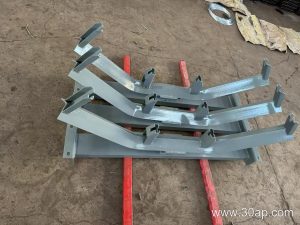
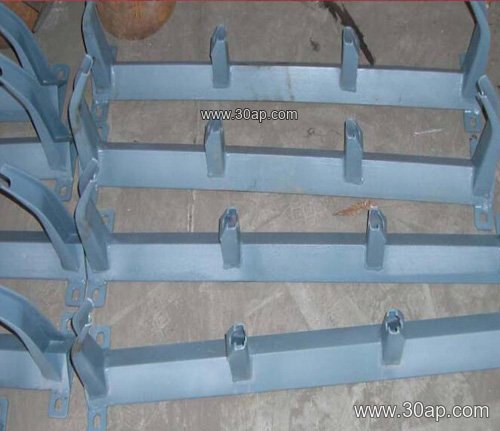
Most heavy-duty brackets are fabricated from angle steel, channel steel, or folded steel plate. The cross beam carries the idler mounts, and the end supports bolt to the conveyor stringer. Welds are continuous at load points, and mounting slots are usually elongated so the frame can be aligned on site rather than forced into place.
Several bracket families exist, and they are not interchangeable:
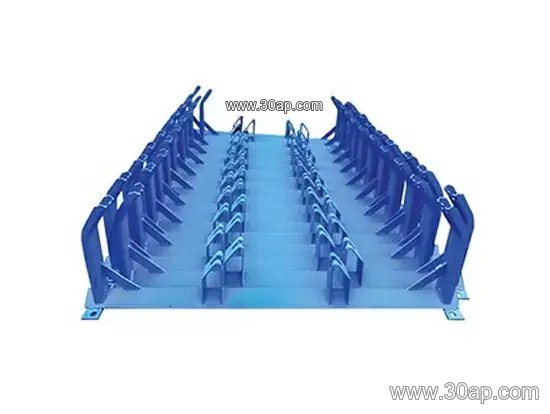
- Trough bracket for the carrying side, setting the trough angle
- Transition bracket near the pulley, where the belt changes from flat to troughed
- Return bracket and V-return bracket under the empty strand
- Impact bracket at the loading point, often paired with impact rollers
- Self-aligning bracket and forward-tilted bracket for tracking control
- Adjustable bracket, which allows the trough angle to be changed in service
An adjustable frame typically covers common trough angles such as 20, 30, 35, and 45 degrees. Forward-tilted designs are often set around 1.5 to 2 degrees to help centre the belt.
Matching Bracket, Belt Width, and Roller Diameter
Bracket geometry follows the belt width and the roller diameter, but there is no single fixed pairing. A B800 frame with a 35 degree trough and Ø108 rollers is a common combination, and a B1200 line may run 45 degrees with Ø133 rollers. Wider installations, such as B1800 or B2000, normally use heavier sections and larger rollers, but the final choice depends on load, speed, and material lump size.
Installation hole spacing and cross beam length change with belt width and trough angle, so these should be taken from the conveyor drawing rather than assumed. The table below shows reference ranges only.
| Belt width | Common trough angle | Typical roller diameter | Frame material |
|---|---|---|---|
| B500 – B650 | 20 – 30 degrees | Ø89 | Angle steel |
| B800 – B1000 | 30 – 35 degrees | Ø108 – Ø133 | Channel steel |
| B1200 – B1400 | 35 – 45 degrees | Ø133 – Ø159 | Channel or folded plate |
| B1600 – B2000 | 35 – 45 degrees | Ø159 – Ø194 | Heavy folded plate |
These figures are indicative and are confirmed by design for each conveyor.
Where It Earns Its Keep
The heaviest duty comes at transfer points. In a limestone quarry or a crushing and screening line, rock falling from a chute hits the belt directly above the impact bracket, so the frame must resist repeated shock without permanent deformation. In a coal preparation plant, flame retardant and anti-static requirements apply to the belt, while the bracket must tolerate fine abrasive dust that works into every joint.
At a power plant coal yard, long overland conveyors use many trough brackets per hundred metres, and a stiffer frame reduces the number of misaligned idlers that need attention. In a cement plant, heat and abrasive clinker dust put similar demands on the carrying-side frames, and a heavy-duty belt such as an abrasion resistant conveyor belt is usually matched with robust supports rather than light ones.
What Buyers Should Check Before Ordering
First, confirm the belt width, trough angle, and roller diameter together with the stringer hole pattern. Second, ask for the steel section thickness and the weld detail at the idler mounts, since these determine service life more than paint finish. Third, decide whether fixed or adjustable frames suit the application: adjustable brackets help during commissioning and when belt behaviour changes, while fixed frames are simpler and stiffer.
Fourth, consider the environment. Wet, corrosive, or highly abrasive sites may justify galvanised or heavily coated frames. Finally, treat the bracket as part of a system with the conveyor belt, the idlers, and the pulleys; a heavy-duty frame paired with undersized rollers will still wear quickly. For long-haul mining duty, frames are often specified alongside a steel cord conveyor belt or a high-strength fabric belt where tension and load are both high.
Ordering the right heavy-duty conveyor bracket is mostly a matter of matching structure to load, and then keeping the mounting dimensions consistent across the whole conveyor so replacement and alignment stay straightforward.