What a Plain Lagged Pulley Is
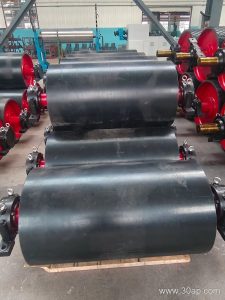
A plain lagged pulley is a conveyor pulley whose cylindrical shell is covered with a smooth rubber or polymer lagging, without grooves, dimples, or ceramic tiles. This plain surface is the key difference from patterned lagging: it offers uniform contact with the conveyor belt, spreads friction evenly, and sheds loose material well. In a belt conveyor system, the pulley that transmits motion is usually a drive pulley, and a plain lagged version is often chosen where the belt needs consistent grip but not the aggressive bite of a patterned surface. The same product is also known as a smooth lagged conveyor pulley, and both terms describe the identical component.
Construction and Surface Options
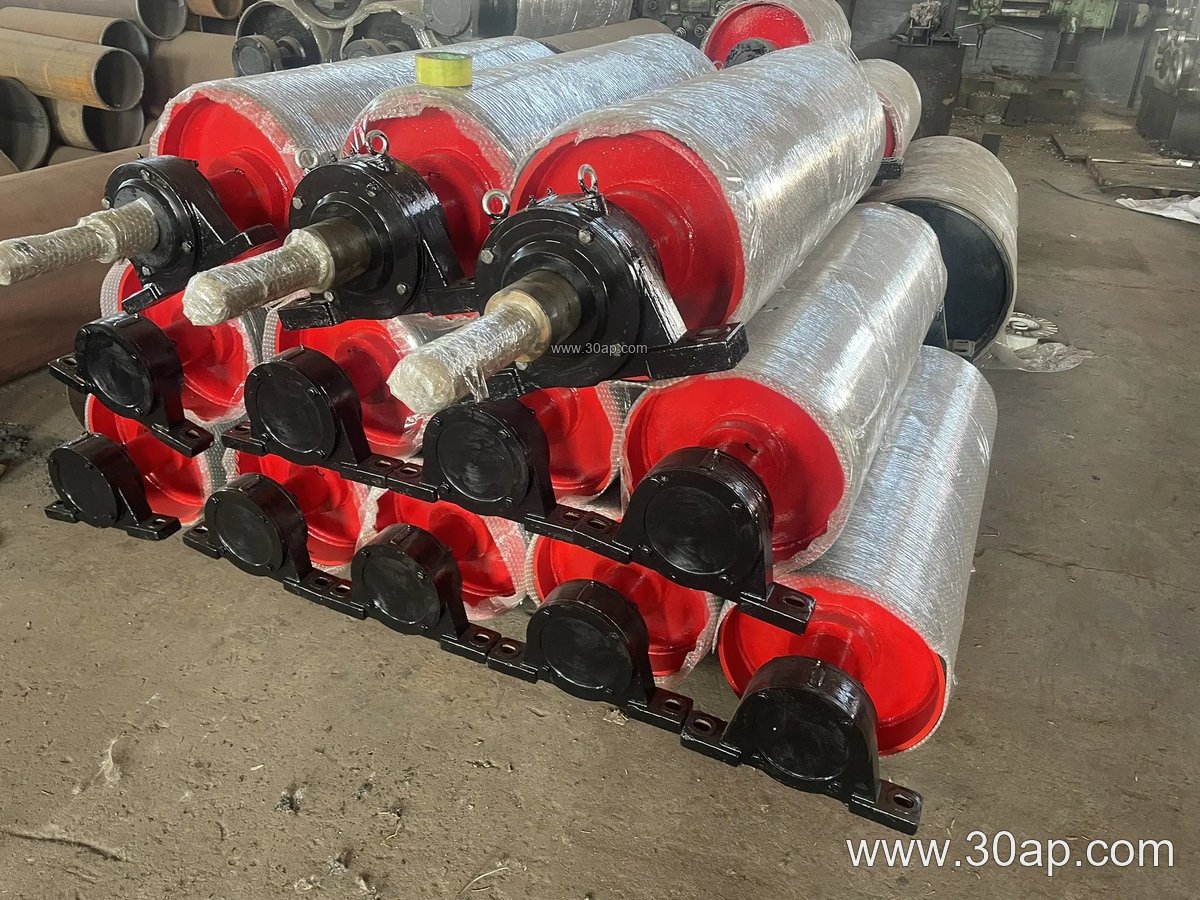
The body is typically a welded steel drum with end discs and a shaft, machined for balance and concentricity. Lagging is applied to the shell in several common ways: hot vulcanized rubber, cold bonded rubber, or cast rubber. Plain lagging is available in thicknesses such as 8 mm, 10 mm, 12 mm, 15 mm, and 20 mm, and the surface can be left as a flat rubber sheet or finished as a plain plane rubber cover. The pulley face width usually exceeds the belt width to allow for belt tracking; for example, a B800 belt commonly runs on a pulley face of about 950 mm, while a B1200 belt may use a face around 1400 mm. These figures are typical references, not fixed rules. Shaft diameter is selected from torque and load calculations, with common values ranging from Ø50 to Ø200, and it should never be guessed from belt width alone.
Common Reference Dimensions
| Belt Width | Typical Pulley Face | Example Diameter | Common Lagging Thickness |
|---|---|---|---|
| B400 | ~500 mm | Ø200, Ø250 | 8, 10 mm |
| B500 | ~600 mm | Ø250, Ø315 | 8, 10 mm |
| B650 | ~750 mm | Ø315, Ø400 | 10, 12 mm |
| B800 | ~950 mm | Ø400, Ø500 | 10, 12 mm |
| B1000 | ~1150 mm | Ø500, Ø630 | 12, 15 mm |
| B1200 | ~1400 mm | Ø630, Ø800 | 12, 15 mm |
| B1400 | ~1600 mm | Ø800, Ø1000 | 15, 20 mm |
| B1600 | ~1800 mm | Ø1000, Ø1250 | 15, 20 mm |
| B1800 | ~2000 mm | Ø1250, Ø1400 | 15, 20 mm |
| B2000 | ~2200 mm | Ø1400, Ø1600 | 20 mm |
The combinations above show that one belt width can match several pulley diameters depending on belt tension, wrap angle, and service duty. For instance, a B1200 belt might work with a Ø800 plain lagged pulley in a low-tension application or a Ø1000 unit where more wrap and traction are required.
Where It Fits in a Conveyor
Plain lagged pulleys appear in drive, tail, and bend positions, but each position calls for different design attention. As a drive pulley, the plain lagging provides steady friction for start-up and running without the material build-up issues that can affect grooved surfaces in wet or sticky conditions. In a tail pulley, a plain lagged shell helps protect the belt and reduce slip when the return side carries fines. A bend or take-up pulley may also use plain lagging to maintain belt alignment without over-gripping. It is important to note that drive, tail, and bend pulleys are not interchangeable; each has its own load profile and mounting arrangement. A plain lagged pulley is often compared with a wing pulley for cleaning ability, but the wing type is a different product and is not a substitute where full belt contact is needed.
Industries and Materials
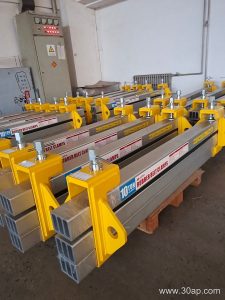
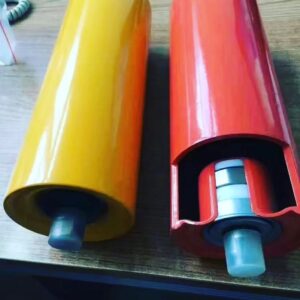
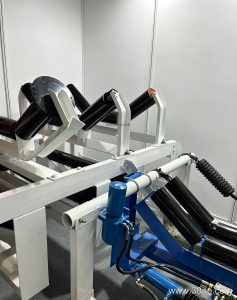
This type of pulley is common in sand and gravel plants, where abrasive dust and variable loads demand a durable but smooth traction surface. It also suits coal washing plants and cement clinker lines, where fine particles can pack into patterned lagging and cause vibration. In a limestone mine or a copper concentrator, a plain lagged drive pulley may be paired with heavy-duty idler rollers and sturdy conveyor brackets to keep the belt centered under high tension. The plain surface is also appreciated in fertilizer handling and grain silos, where product contamination and belt wear are concerns.
Buyer Checklist
- Confirm the pulley position (drive, tail, bend) and the required traction, since plain lagging is not ideal for every high-torque drive.
- Specify belt width, pulley face width, and diameter as a set; do not assume a fixed diameter for a given belt width.
- Choose lagging thickness and material based on abrasion, moisture, and belt cleanliness; 8–20 mm covers many common duties.
- Provide shaft diameter, keyway, and bearing centers from the conveyor design, not from a belt-width rule of thumb.
- Check that the pulley will be balanced and that the lagging is bonded to suit the environment, especially in dusty or wet plants.
- Ask for the surface finish and tolerance so the belt tracks correctly against the conveyor frame and brackets.
Matching a plain lagged pulley to the belt, idler rollers, and conveyor bracket layout is a matter of design calculation rather than a single catalog number. Used with the right specifications, it delivers quiet, even traction in many bulk handling operations.