What a Conveyor Belt Support Frame Does
A conveyor belt support frame is the structural backbone that holds the rollers in position along a conveyor line. It sits between the stringers or the side rails and gives each idler roller a fixed or adjustable mounting point. Without this steel frame, the rollers would have no stable alignment, and the conveyor belt would track poorly, sag between stations, or rub against the structure.
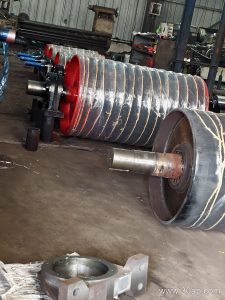
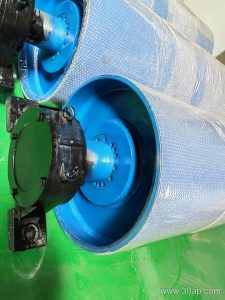
In everyday workshop language, this part is also called a conveyor roller bracket or idler support frame. It is not a pulley, and it should not be confused with a drive pulley, a tail pulley, or a bend pulley. Those are rotating drums that transmit power or change belt direction, while the support frame is a stationary mounting structure for carrying rollers.
How the Frame Is Built
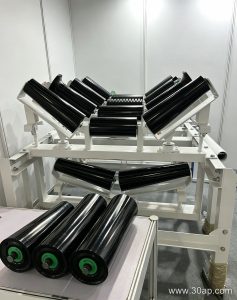
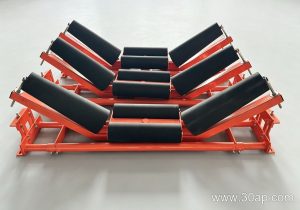
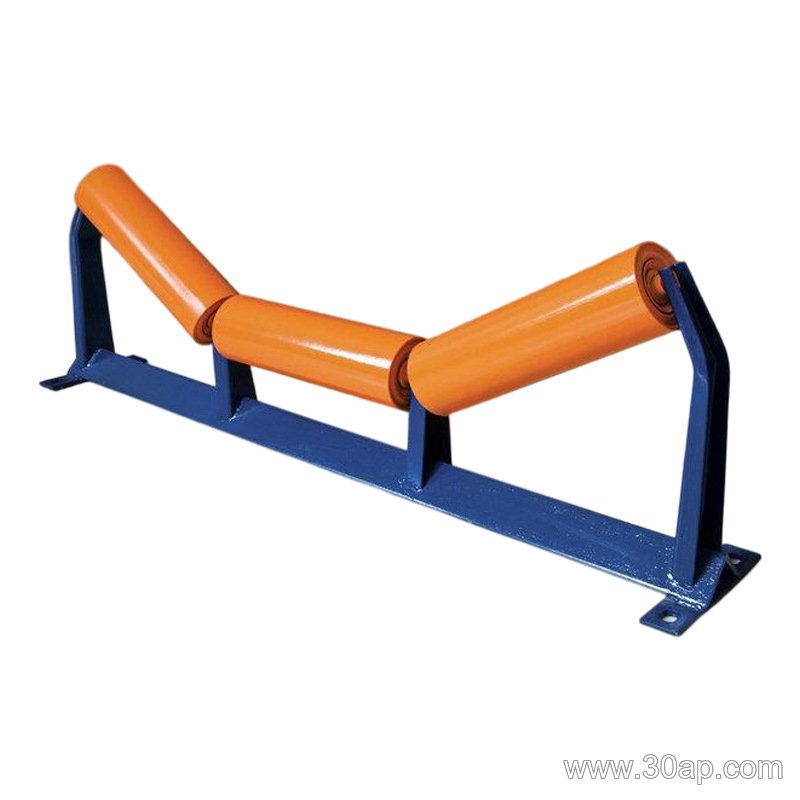
Most frames are fabricated from angle steel, channel steel, or folded steel plate. The choice depends on the load, the belt width, and the spacing between frames. A typical troughing frame has two inclined mounting faces and one flat or slightly raised centre position, so three rollers form a trough that cups the belt.
Common build details include:
- Welded or bolted cross beams sized to the belt width
- Slotted holes that allow roller position adjustment
- Reinforced corners where the frame meets the main stringer
- Powder coating, painting, or galvanising for corrosion protection
Mounting hole spacing and beam length change with belt width and trough angle. They are not fixed numbers, so a buyer should always confirm them against the actual conveyor drawing.
Types and Where They Fit
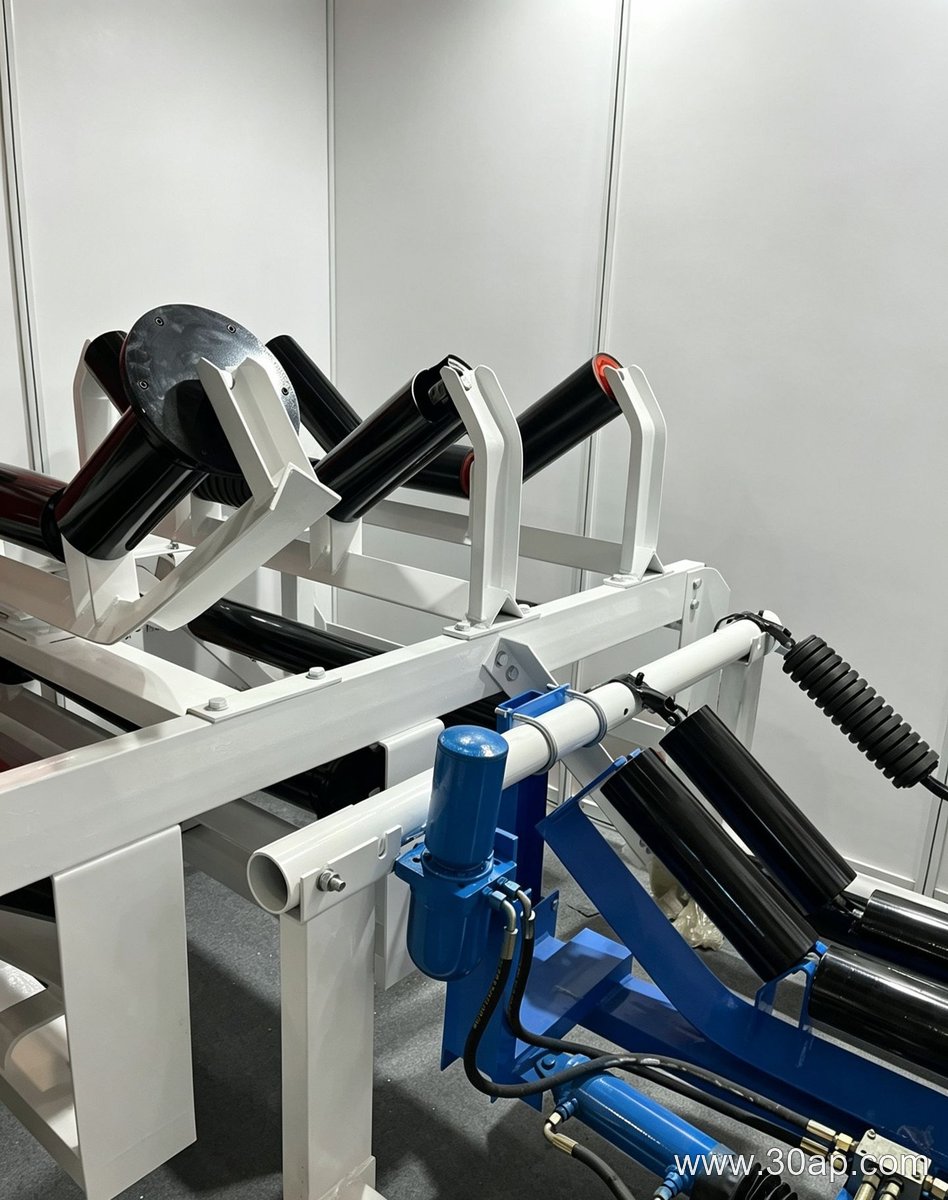
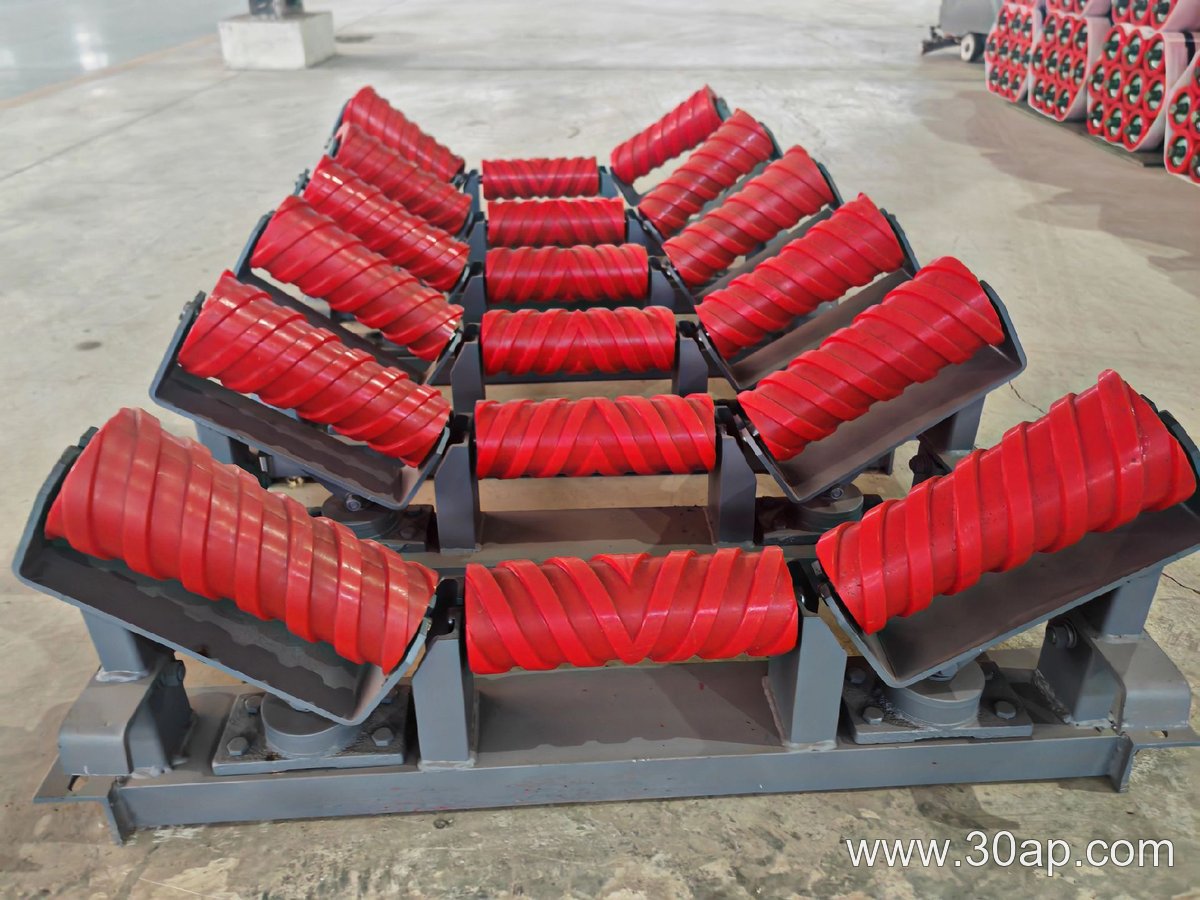
Support frames appear at several points along a conveyor. Troughing frames carry the loaded belt on the carrying side. Return frames support the empty belt underneath. A V-shaped return frame helps centre the belt on the return run. Impact frames sit below the loading chute and carry rubber-covered impact rollers. Self-aligning frames use pivoting or forward-tilted rollers to correct belt drift.
Adjustable frames let maintenance crews change the trough angle on site, usually between 20 degrees, 30 degrees, 35 degrees, and 45 degrees. A fixed frame is welded at one angle and is simpler and stiffer. Forward tilt, often around 1.5 to 2 degrees, is a separate feature of certain self-aligning or forward-tilted roller sets, not a property of every frame.
Typical matching data for a support frame may look like this:
- Belt width: B500, B650, B800, B1000, B1200, B1400, B1600, B1800, B2000, B2200
- Trough angle: 20 degrees, 30 degrees, 35 degrees, 45 degrees
- Roller diameter: Ø89, Ø108, Ø133, Ø159, Ø194
These values are reference examples, not a fixed rule. A B800 belt can run with different roller diameters and trough angles depending on the material, the load, and the conveyor design. One belt width does not lock the frame to one roller size or one angle.
Where These Frames Are Used
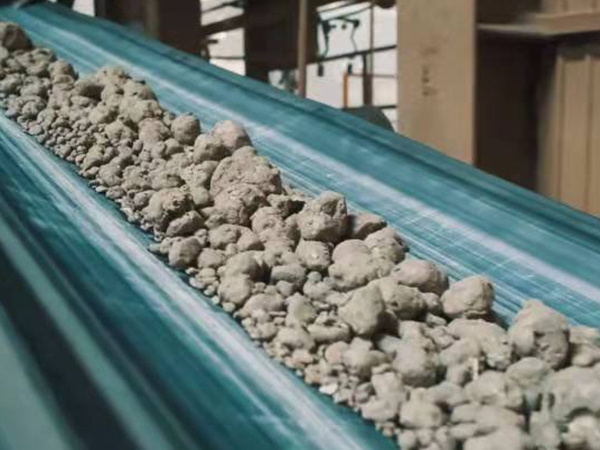
Support frames are found wherever bulk material moves on a belt. In a quarry or a sand and gravel line, they hold troughing rollers under crushed stone. In a coal handling plant or a power station coal yard, they carry the belt through long transfer runs. Other common sites include cement plants, iron ore concentrators, fertiliser plants, and grain silos.
Each location puts different demands on the frame. Abrasive and heavy ore calls for thicker steel and closer frame spacing. Grain and fertiliser may need smoother surfaces and better corrosion protection. A tunnel spoil line may need frames that resist dust and moisture.
What a Buyer Should Check
Before ordering, confirm the belt width, the required trough angle, and the roller diameter. Check the mounting hole pattern and the beam length against the existing stringer. Ask whether the frame is fixed or adjustable, and whether it is for the carrying side or the return side. Also confirm the material thickness and the surface treatment.
The frame works together with the conveyor belt, the idler roller, the conveyor pulley, and the conveyor bracket. A poorly matched frame can shorten roller life and cause belt mistracking, so it is worth treating the support frame as a precision part rather than a simple piece of steel.