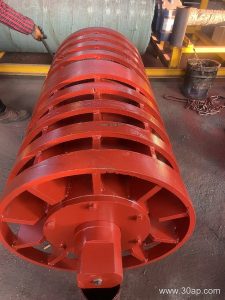
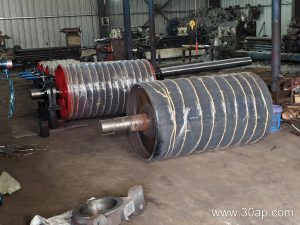
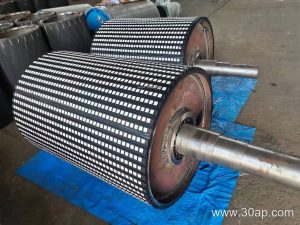
What a Take-Up Device Pulley Does
A take-up device pulley is the drum that a belt conveyor uses to maintain tension as the belt runs. Mounted in a take-up station, usually near the tail end or on a sliding carriage, it moves along a track so the belt stays snug against the drive pulley and the carrying idlers. Without that controlled tension, a conveyor belt can slip, sag between idler roller stations, or wander off its tracking. In a quarry, a cement plant, or a power plant coal yard, a well-set take-up pulley keeps the whole line stable through start-up, load changes, and the slow stretch that any fabric or steel cord belt develops over time.
The take-up device pulley is also called a tension pulley, and both names describe the same component. It should not be confused with the drive pulley, which transmits power, or with the tail pulley and bend pulley, which serve different positions in the conveyor layout.
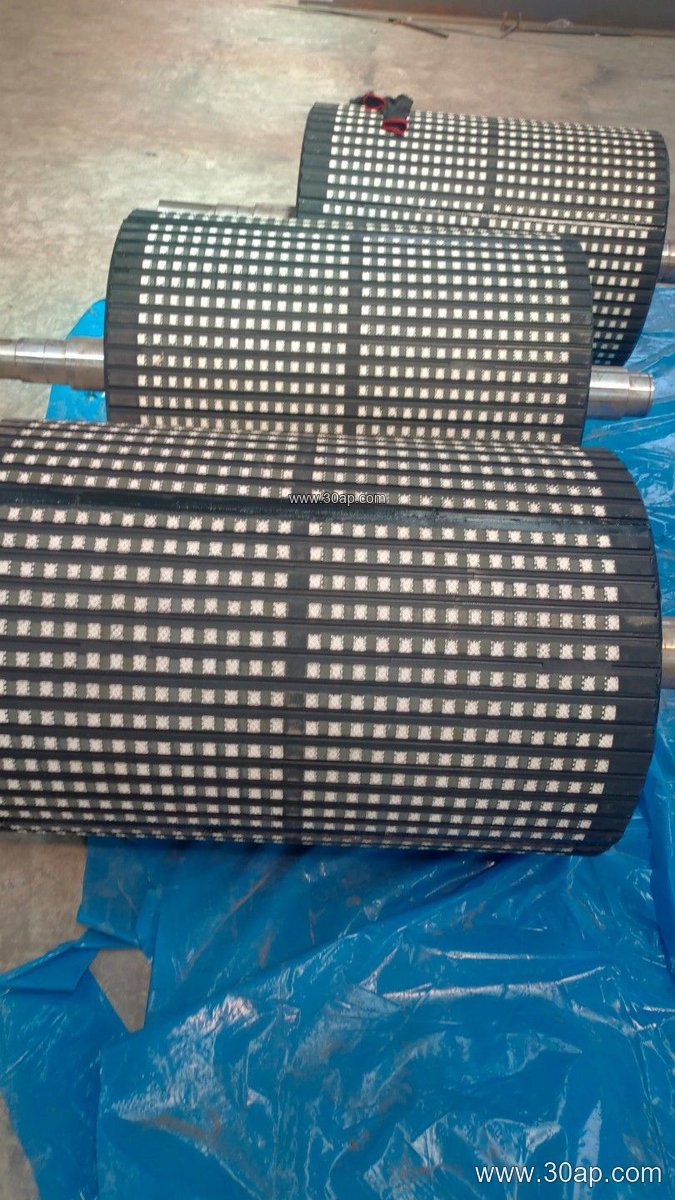
Construction and Surface Options
The drum is typically a welded steel shell with machined end discs, a through shaft, and bearing housings that sit in the take-up carriage. Shell diameter and face width are matched to the belt and the tension load, not to a single fixed rule. A B800 conveyor might run a pulley around Ø500, while a B1400 line may use Ø800 or larger; the shaft diameter is chosen from torque and bearing load, commonly Ø80 to Ø160 on medium and heavy conveyors.
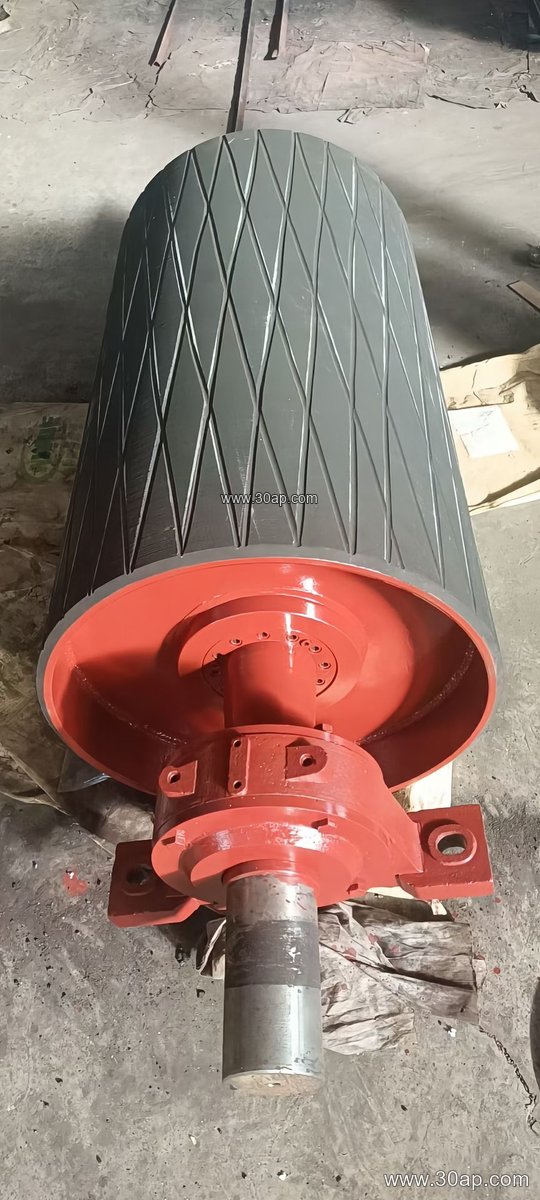
Surface treatment depends on grip and environment. Plain finish suits many take-up positions where friction is not critical. Rubber lagging, applied as cold-bonded or hot-vulcanized sheet, improves traction and protects the shell. Diamond or herringbone grooving helps shed water and fines, while ceramic lagging is chosen where abrasive dust is constant. Lagging thickness commonly falls between 8 mm and 20 mm.
| Parameter | Common reference values |
|---|---|
| Belt width | B500, B650, B800, B1000, B1200, B1400, B1600 |
| Pulley diameter | Ø315, Ø400, Ø500, Ø630, Ø800, Ø1000 |
| Face width examples | B800 about 950 mm, B1000 about 1150 mm, B1200 about 1400 mm |
| Shaft diameter | Ø60, Ø80, Ø100, Ø120, Ø140, Ø160 |
| Lagging | Plain, cold-bonded rubber, hot-vulcanized rubber, diamond, ceramic |
Where It Fits in the Plant
In an underground coal mining conveyor, the take-up pulley often sits on a gravity carriage that follows the belt as it stretches, keeping tension steady where space is tight. In a limestone quarry or aggregate line, a screw-type take-up may be used on shorter conveyors feeding a crusher. The same drum appears in cement plant clinker transport, port bulk handling, and steel plant sinter lines. Its job is consistent: hold tension without overloading the belt or the bearings.
Selection should consider the conveyor belt type as well. A heavy abrasion resistant conveyor belt on an ore conveyor may need a larger drum to limit bending stress, while a lighter EP conveyor belt on a short transfer can work with a smaller shell. The take-up pulley also interacts with the conveyor bracket and frame, so carriage travel, mounting height, and bearing access should be checked before ordering.
Buyer Checklist
- Confirm belt width, pulley face width, and required take-up travel.
- State the belt construction, such as multi-ply fabric core or steel cord, so the drum diameter can be reviewed against bending limits.
- Choose lagging by environment: plain for dry clean service, grooved rubber for wet or dusty conditions, ceramic for high abrasion.
- Verify shaft diameter from calculated torque and bearing load rather than belt width alone.
- Check bearing type, housing fit, and lubrication access on the take-up carriage.
A take-up device pulley is a small part of the conveyor but a decisive one for belt life and tracking. Matching it to the belt, the load, and the site conditions is the practical way to avoid slip and premature wear.