What a Trough Idler Does on the Carrying Side
A trough idler is the group of rollers that supports the loaded run of a conveyor belt and shapes it into a trough. The angled side rollers lift the belt edges, so bulk material sits in a cradle instead of spilling over the edges. In a quarry or a sand and gravel line, this shape is what keeps crushed stone centered on the belt between the loading point and the head pulley. The same carrying idler set appears in cement plants, power plant coal handling, and iron ore or copper ore circuits, usually in long repeating frames.
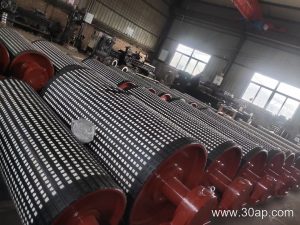
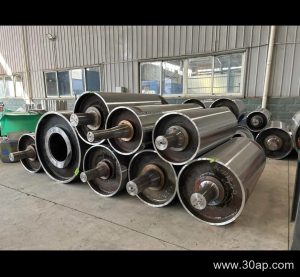
The trough idler is a distinct product from the return idler, the impact idler, and the self-aligning idler, and it should never be confused with a conveyor pulley. Drive pulleys, tail pulleys, and bend pulleys each do a different job at the ends or bends of the conveyor, while the trough idler works along the carrying span. A conveyor pulley transmits or redirects belt tension; a trough idler only carries the belt and the material on it.
How the Roller Set Is Built
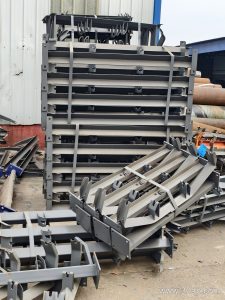
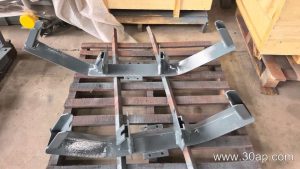
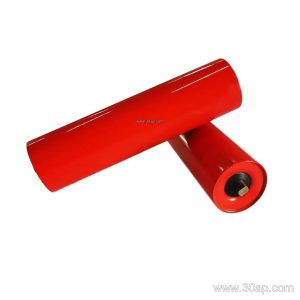
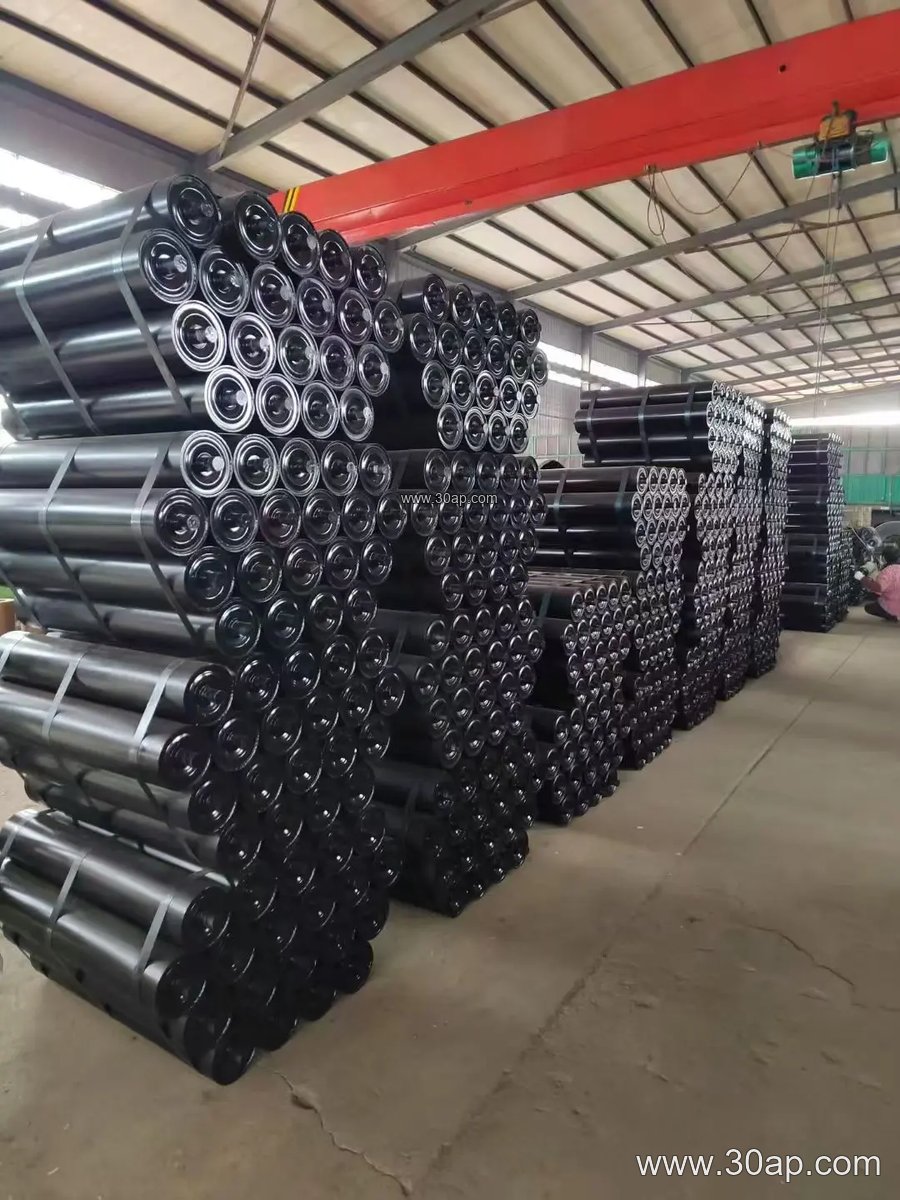
A typical assembly has two or three rollers mounted in a steel frame, with the side rollers set at a trough angle. Each roller is a tube with end caps, a shaft, and bearings, and the frame is fixed to the conveyor bracket on the stringer. Common roller diameters include Ø89, Ø108, Ø127, Ø133, and Ø159 mm, and heavier installations may use Ø178 or Ø194 mm. Bearings such as 6204, 6205, 6305, 6306, 6308, and 6310 are common, but a given bearing is not tied to one roller diameter.
Roller length follows belt width, trough angle, and the number of rollers in the set. For a three-roller trough set, common roller lengths are roughly 200 mm for B500, 250 mm for B650, 315 mm for B800, 380 mm for B1000, 465 mm for B1200, 530 mm for B1400, 600 mm for B1600, 670 mm for B1800, and 750 mm for B2000. These are examples, not fixed pairings, and the side rollers and center roller can differ. A 1200 mm wide conveyor belt does not automatically dictate one pulley diameter or one shaft size.
Roller Surface and Sealing Choices
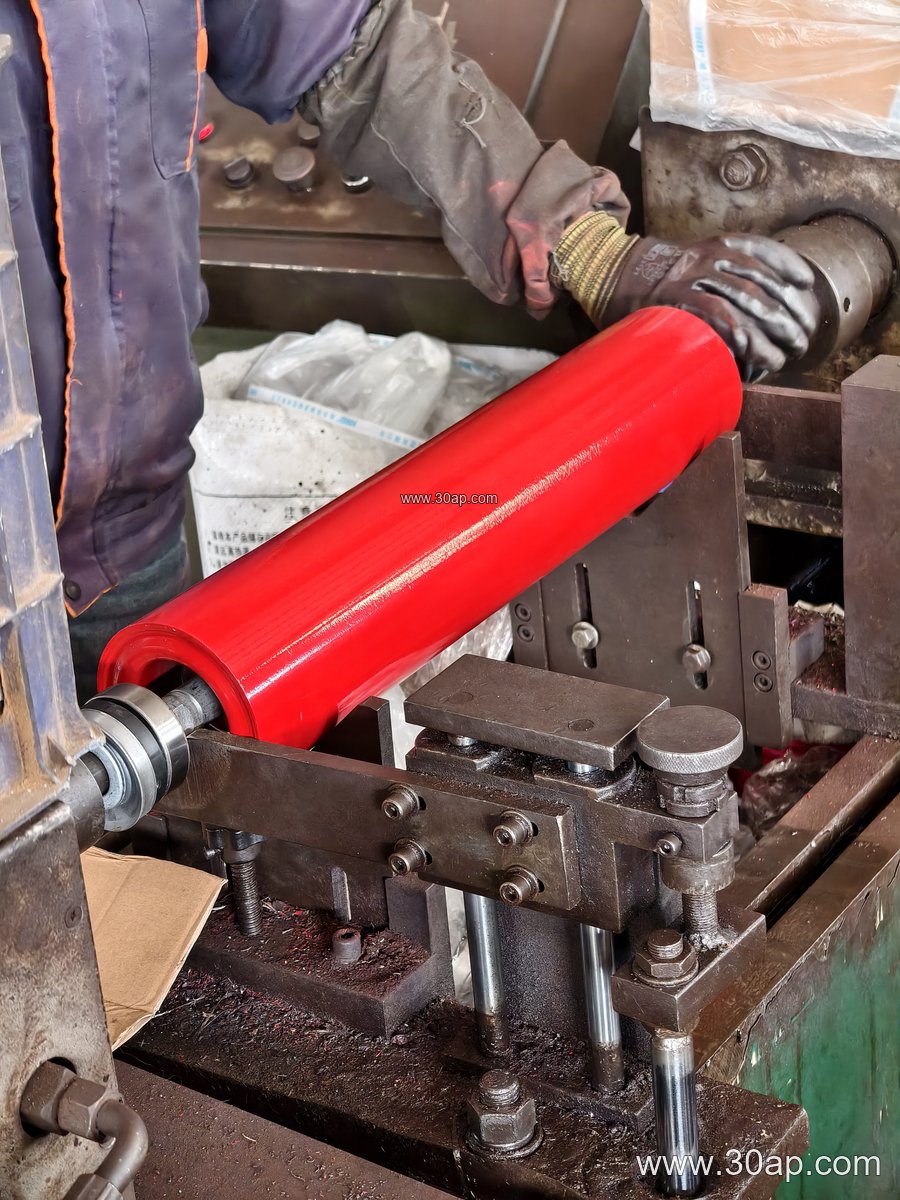
Roller shells are usually steel tube, and some designs add nylon, ceramic, or rubber rings. Rubber rings are more often seen on impact idlers at transfer points, where falling rock would damage a plain shell. Sealing matters in dusty service: a labyrinth seal or a well-fitted bearing housing keeps fines out of the bearing cavity. In a coal preparation plant or a limestone crushing circuit, poor sealing shortens roller life long before the tube wears through.
Trough Angle and Belt Loading
The trough angle controls how deeply the belt is cupped. Common angles are 20, 30, 35, and 45 degrees. A 20-degree set is gentle and suits thin or flexible belts and light material; a 35- or 45-degree set holds a larger load cross-section on a wide belt, which is useful on high-capacity ore and aggregate lines. The angle must match the belt’s flexibility, because a stiff fabric belt may not seat properly in a deep trough.
Three-roller sets are the usual choice for medium and wide belts, while two-roller sets appear on narrower conveyors. A single-roller set is closer to a flat carrying arrangement and is used where the belt is narrow or the material is fine. Transition idlers, placed near the head and tail, gradually change the belt from flat at the pulley to fully troughed in the carrying span, reducing edge stress.
Where Trough Idlers Are Used
In a coal mine or an underground coal mining conveyor, trough idlers support a flame retardant conveyor belt or a PVG conveyor belt along the gate road and the main trunk. In a cement plant, they carry clinker and raw meal on heat resistant conveyor belt sections where temperature is a concern. In a port or ship loading system, wide trough sets support a 1400 mm or 1600 mm conveyor belt moving bulk material at high tonnage. A crusher conveyor belt and a quarry conveyor belt also depend on trough idlers to keep sharp rock away from the belt edges.
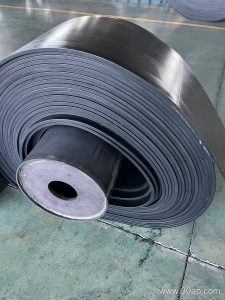
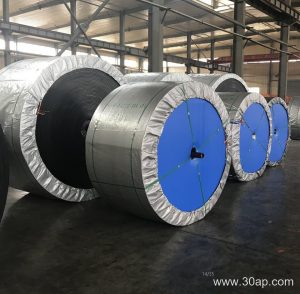
The belt itself may be a rubber conveyor belt, an EP conveyor belt, an NN conveyor belt, a fabric core conveyor belt, a steel cord conveyor belt, or a multi-ply fabric core conveyor belt. Heavier belts such as ST1600 or ST2000 need a robust idler frame and adequate bearing capacity, but the trough idler selection still follows belt width, load, speed, and environment rather than the belt grade alone.
Buyer Checklist
- Confirm belt width (B400 to B2400), trough angle, and whether the set is two-roller or three-roller.
- Match roller diameter and bearing size to the actual load and speed, not to a rule of thumb.
- Check the frame and conveyor bracket dimensions so the set fits the existing stringer.
- For dusty or wet service, ask about seal type and bearing housing protection.
- For transfer points, consider a rubber-ring impact idler instead of a standard trough idler.
- Keep spare rollers and frames consistent with the installed series to simplify maintenance.
Inspection is simple: listen for a seized roller, look for a belt that runs off-center, and check for material buildup under the frame. Replacing a worn trough idler early protects the belt and the downstream conveyor pulley. For a full carrying-side layout, match the trough idler series to the belt, the load, and the site conditions, and confirm every dimension with the supplier before ordering.