What a Trough Idler Bracket Set Does on a Conveyor
A trough idler bracket set is the steel mounting group that holds the carry-side idler rollers in a troughed profile so the conveyor belt forms a stable, cupped channel for bulk material. Often called a troughing idler frame set or carry-side idler support set, it is the interface between the idler roller and the conveyor stringer. In a stone crushing line or a cement plant, the bracket set determines whether the belt sits evenly, whether the load stays centered, and how quickly worn rollers can be swapped out.
The bracket set is not a pulley. Drive pulleys, tail pulleys and bend pulleys transmit or redirect belt tension, while the trough idler bracket set only supports the belt between those pulleys. Confusing the two leads to wrong spare parts and unnecessary downtime.
How the Bracket Set Is Built
Most sets combine a base crossbeam with two or three inclined idler seats. Common materials are angle steel, channel steel and folded steel plate, selected for stiffness under load and for corrosion resistance in wet or dusty service. A three-roller arrangement is typical, with a central flat position and two angled wings; a two-roller V arrangement appears on some return-side and special carry-side layouts.
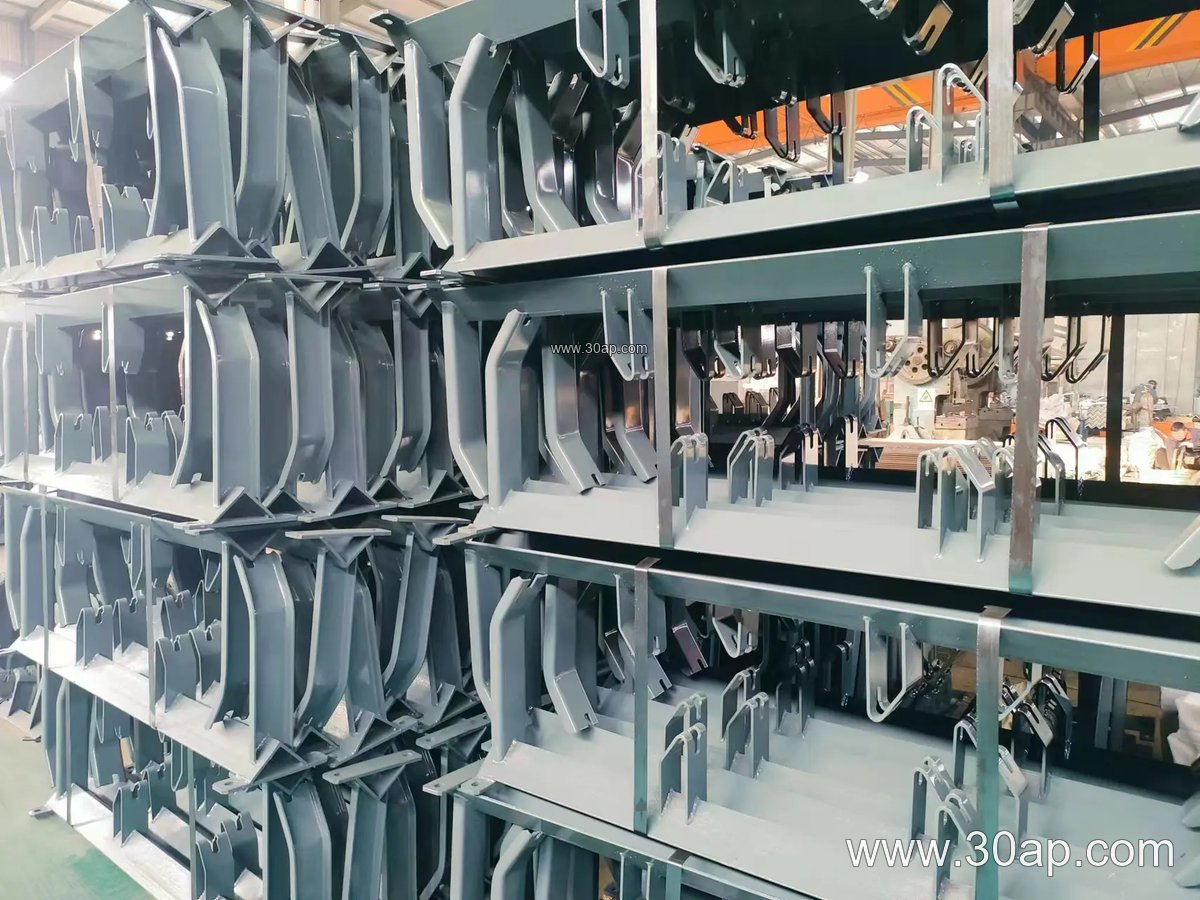
Key construction details a buyer should confirm include mounting hole spacing, crossbeam length, slot angle and the idler diameter the seats accept. These values follow belt width and design requirements, so they are usually stated as common or typical rather than fixed for every conveyor.
- Fixed bracket: welded or bolted at a set trough angle, simple and rigid.
- Adjustable bracket: seats can be repositioned across common trough angles such as 20, 30, 35 and 45 degrees.
- Forward-tilt bracket: seats leaned about 1.5 to 2 degrees to help belt tracking.
- Impact bracket: reinforced seats for loading zones under crusher discharge.
Where Trough Idler Bracket Sets Are Used
These sets appear wherever a conveyor belt carries loose material. In a coal washing plant or power station coal yard, they support the loaded run through transfer points and long galleries. In a limestone quarry or aggregate plant, they guide abrasive stone and gravel at steady speed. In a fertilizer or grain silo facility, lighter-duty sets keep fragile material moving without spillage. The same hardware family is used in tunnel spoil handling and in port ship-loading lines.
Matching the bracket to the belt matters. A heavy-duty mining conveyor belt with a thick cover and high tension needs a stiffer frame than a light fabric core belt on a short run. An abrasion resistant conveyor belt carrying sharp ore asks for robust seats and good roller alignment, while a heat resistant conveyor belt near a kiln discharge needs brackets that keep their shape under thermal cycling.
Trough Angle, Belt Width and Roller Diameter
There is no single correct combination. Belt width, trough angle and roller diameter are chosen together with capacity, material angle of repose and belt stiffness. The table below shows common reference combinations, not mandatory matches.
| Reference | Belt width | Trough angle | Roller diameter |
|---|---|---|---|
| Light duty | B650 | 30 degrees | Ø89 |
| General duty | B800 | 35 degrees | Ø108 |
| Medium duty | B1200 | 45 degrees | Ø133 |
| Heavy duty | B1400 to B1800 | 35 or 45 degrees | Ø159 or Ø194 |
Belt widths from B500 to B2200 are common across bulk handling, and wider belts generally need longer crossbeams and heavier sections. A 1200mm wide conveyor belt and a 1800mm wide conveyor belt can share a similar bracket style but not the same dimensions. Always confirm hole pitch and beam length against the actual stringer drawing.
Buyer Checklist
- Confirm belt width, trough angle and roller diameter before ordering.
- State whether fixed or adjustable seats are required, and whether forward tilt is needed.
- Check material and finish for wet, corrosive or high-temperature areas.
- Ask for mounting hole spacing and crossbeam length rather than assuming them.
- Plan spares around the idler roller size already in use to avoid mixed sets.
For a quarry or a coal handling plant, a well-matched trough idler bracket set keeps the belt aligned, protects the idler roller bearings and simplifies maintenance. Pair it with the right conveyor belt grade and roller quality, and the carry side runs quieter and longer.