What a Self-Aligning Idler Bracket Does
A self-aligning idler bracket is the mounting frame that holds the training idlers on a conveyor and lets them pivot slightly so the belt stays centred. It is often called a self-tracking idler bracket or a training idler frame, and it works as a small steering system rather than a fixed support. When a conveyor belt drifts toward one side, the skewed rollers in this bracket turn against the belt edge and gently push it back. That makes it a practical addition on long runs where misalignment causes edge damage, spillage and extra wear.
The bracket is common in quarry lines, coal handling plants and cement works, where dust, uneven loading and long distances all encourage belt wander. It is usually paired with a conveyor belt that has good edge strength, such as an EP conveyor belt or a heavy-duty mining conveyor belt, because tracking correction puts extra load on the belt edges.
How the Bracket Is Built
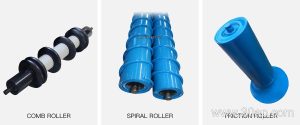
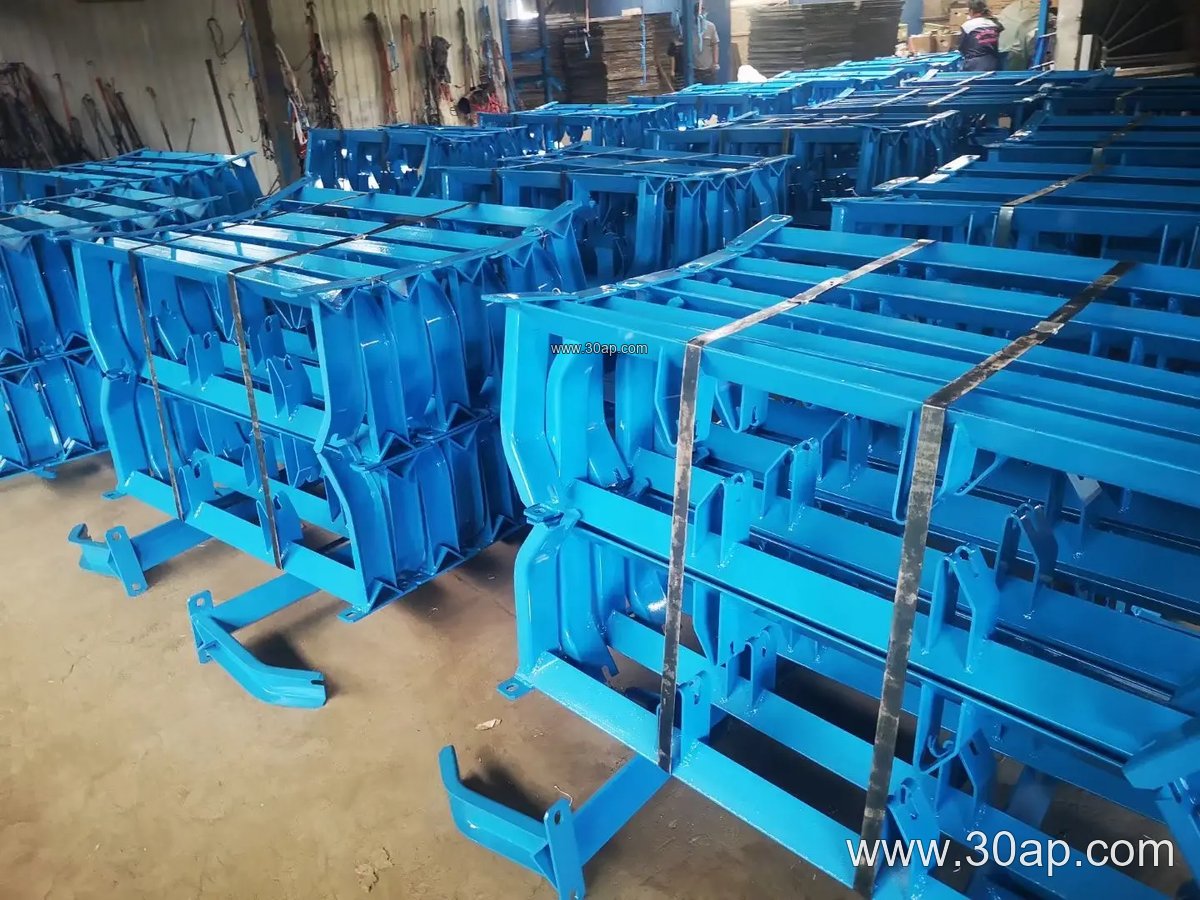
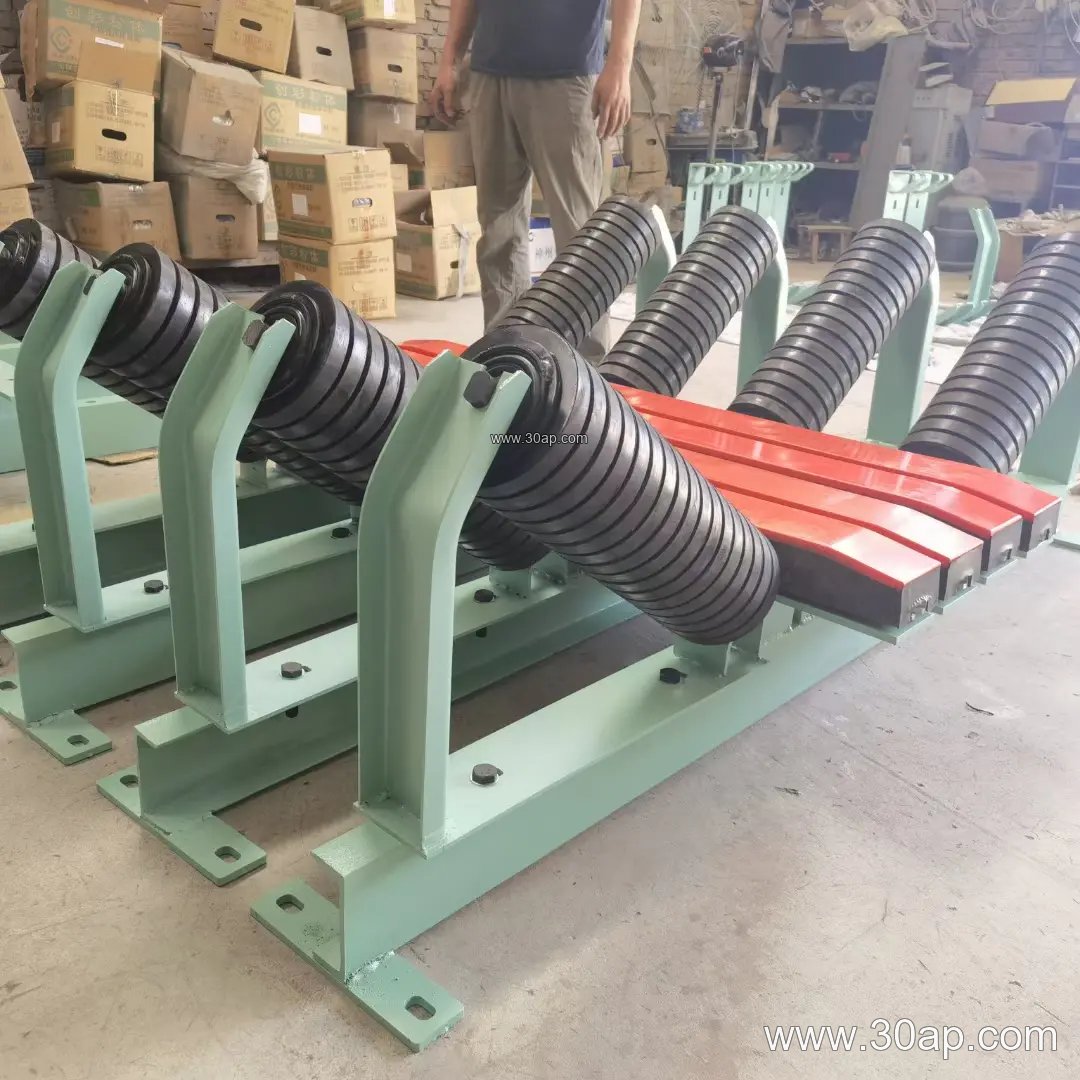
Most units use a welded frame made from angle steel, channel steel or folded steel plate. The frame carries two or three idler roller positions and sits on a central pivot so the whole assembly can rotate a few degrees. A vertical pivot pin, a thrust bearing and a pair of limit stops are typical. The rollers themselves are often standard carrying idlers or rubber-disc training rollers, mounted at a slight lead angle.
Because the pivot is the heart of the design, the frame needs to be stiff enough not to twist under load. Buyers should look at weld quality, paint or galvanising, and whether the pivot has a grease point. A sealed pivot lasts longer in wet or dusty service, especially in a wash plant or a port terminal.
Where It Fits on the Conveyor
A self-aligning idler bracket is normally installed on the carrying side, a short distance after the loading point, and again before the head pulley where drift tends to build up. Some plants also use a return-side version under the belt to correct the empty strand. It is not a substitute for a bend pulley or a tail pulley; those change belt direction, while the bracket only adjusts tracking. Likewise, a fixed troughing bracket and a self-aligning bracket do different jobs, and the two are often used on the same conveyor at different stations.
Typical mounting positions include:
- Downstream of the feed chute, where off-centre loading starts the drift
- Mid-span on long overland or plant conveyors
- Ahead of the discharge pulley on the carrying run
- On the return strand, using a V-return or flat-return training frame
In a coal mining conveyor or an underground mining conveyor, the bracket must also cope with confined space and limited maintenance windows, so bolt-on designs are preferred over welded ones.
Matching the Bracket to Belt Width and Trough Angle
The bracket is selected together with belt width, trough angle and roller diameter. These values are related but not locked to each other; a B800 belt, for example, may run at 30 or 35 degrees with Ø108 or Ø133 rollers depending on the conveyor design. The table below shows common reference combinations, not fixed rules.
| Belt width | Trough angle | Roller diameter | Typical use |
|---|---|---|---|
| B500 | 20° or 30° | Ø89 | Small plant conveyors, sand and aggregate lines |
| B650 | 30° | Ø89 or Ø108 | Crushing and screening circuits |
| B800 | 30° or 35° | Ø108 | Quarry and cement plant duty |
| B1000 | 35° | Ø108 or Ø133 | Coal handling, power plant coal feed |
| B1200 | 35° or 45° | Ø133 | Iron ore, heavy bulk material |
| B1400 | 35° or 45° | Ø133 or Ø159 | Port terminals, ship loading |
| B1600 | 45° | Ø159 | Large tonnage primary conveyors |
| B1800 and above | 35° or 45° | Ø159 or Ø194 | Mine haulage and high-capacity trunk lines |
Installation hole spacing and crossbeam length change with belt width and trough angle, so the bracket should be ordered against the actual conveyor drawing rather than a nominal size alone. Adjustable brackets allow the trough angle to be set between about 20 and 45 degrees on site, and the lead angle on training rollers is usually around 1.5 to 2 degrees.
What Buyers Should Check
Before ordering a self-aligning idler bracket, confirm the belt width, the required trough angle, the roller diameter and the mounting hole pattern. Ask whether the frame is fixed or adjustable, and whether the pivot is protected against dust and water. Check that the bracket suits the belt type in use: a steel cord conveyor belt behaves differently from a multi-ply fabric core conveyor belt, and a chevron conveyor belt or corrugated sidewall conveyor belt may need extra clearance around the training frame.
Also consider the environment. A heat resistant conveyor belt in a sinter plant or a flame retardant conveyor belt in a coal mine may call for a bracket with heat-tolerant paint and a protected bearing. In a fertiliser or grain silo, a corrosion-resistant finish is more important than heavy steel. Finally, keep a small stock of spare pivots and pins; the bracket is inexpensive compared with the cost of a damaged belt edge.