What the Coating Does for a Conveyor Idler
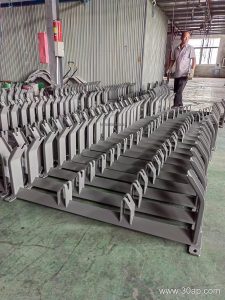
A hot-dip galvanized idler is a carrying or return roller whose steel components receive a zinc bath after fabrication. The zinc bonds metallurgically to the steel, forming a layer that resists rust in damp tunnels, coastal ports, and open stockyards. Unlike paint, the coating reaches inside corners and along weld seams, which matters on a conveyor bracket that sees washdown or seasonal condensation. For a quarry conveyor belt or an underground coal mining conveyor belt, this protection translates into fewer frozen rollers and less downtime for replacement. The part remains an idler roller first; galvanizing is a surface treatment, not a change in the roller’s mechanical role.
Construction and Sealing Details
Most hot-dip galvanized idlers start as a steel tube fitted with bearing housings, a shaft, and end caps. Common roll diameters include Ø89, Ø108, Ø127, Ø133, Ø159, and Ø178 mm, with larger sizes for heavy bulk material conveyor belts. The galvanizing step usually happens before bearing insertion, so the raceways stay clean; some manufacturers use a masked or plugged design to keep zinc out of the bearing seat. Seals are typically labyrinth or lip type, and the bearing number is selected by load and speed, not by roll diameter alone. A 6205 bearing may appear in a smaller troughing roll, while a 6308 or 6310 is more common on larger return positions. A buyer should ask whether the shaft ends and the bracket contact faces are also coated, because bare steel there can corrode and seize.
Where Galvanized Idlers Earn Their Keep
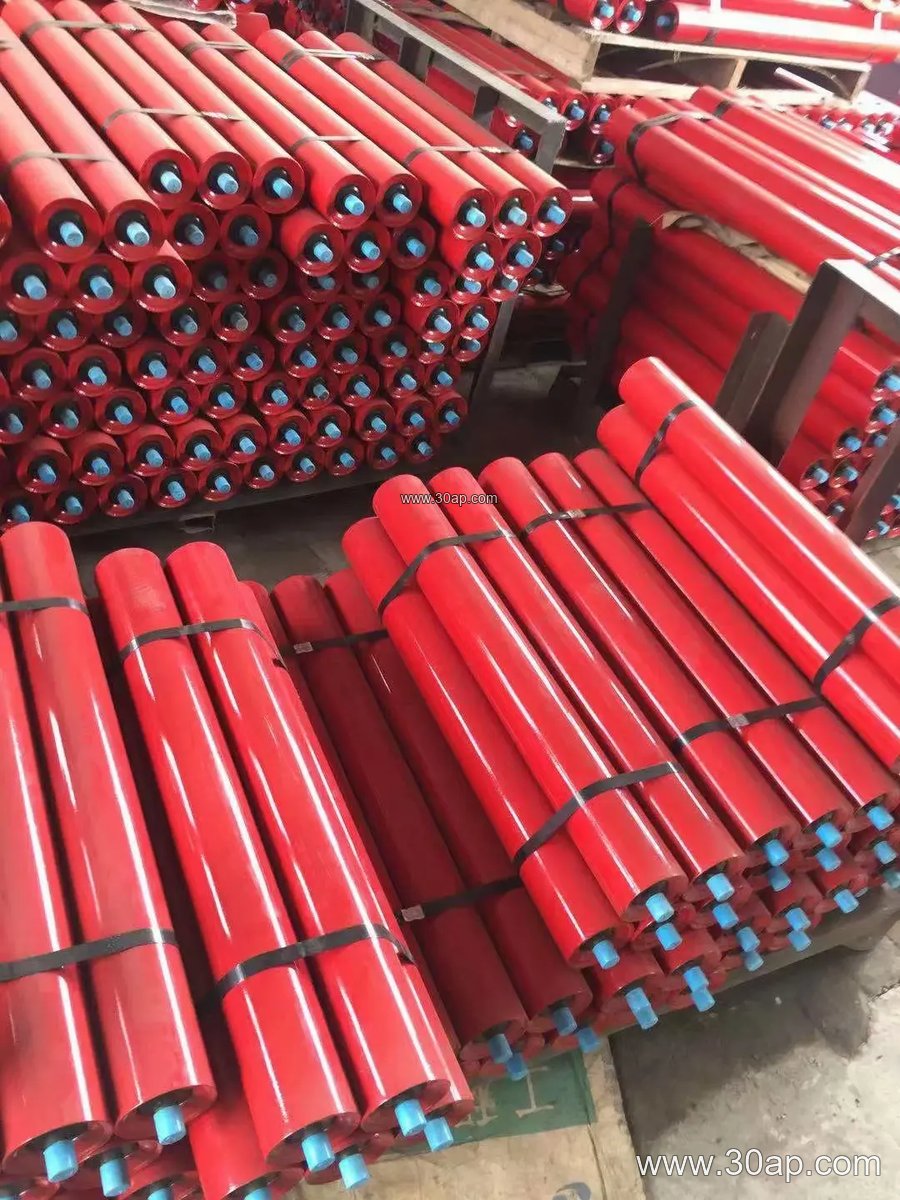
Aggregate and ore handling are the obvious settings. In a limestone quarry, a hot-dip galvanized idler on the return side resists the fine, damp dust that settles under the belt. At a port handling iron ore or copper ore, salt air attacks plain painted rollers quickly, so galvanized troughing and return sets are a practical choice. Power plant coal yards and cement plant clinker lines also use them where washdown or humidity is constant. The same roll type fits a conveyor bracket on a ship loading conveyor belt or a crusher conveyor belt, though the belt itself may be a heavy-duty mining conveyor belt, an abrasion resistant conveyor belt, or a flame retardant conveyor belt depending on the hazard.
Matching Idler Size to Belt and Structure
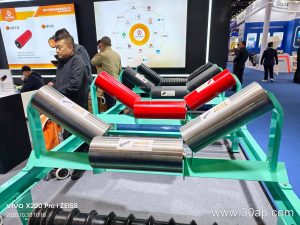
Roll length follows belt width, trough angle, and the idler set form. A three-roll troughing set might use roughly 200 mm rolls on a B500 belt, 315 mm on B800, 465 mm on B1200, and 600 mm on B1600, but side rolls and center rolls can differ, and these are common examples rather than fixed pairings. Trough angles of 20, 30, 35, and 45 degrees change the roll geometry and the material profile. A buyer should confirm the belt width, the existing bracket hole spacing, and the shaft diameter before ordering; a 1000mm conveyor belt does not dictate one shaft size, and a 1200mm wide conveyor belt can appear with several bearing classes. For comparison, a bend pulley or drive pulley is a different component with its own shaft and lagging, so idler dimensions cannot be swapped with pulley dimensions.
Specification Snapshot
| Parameter | Common range or note |
|---|---|
| Roll diameter | Ø63, Ø76, Ø89, Ø102, Ø108, Ø127, Ø133, Ø159, Ø178, Ø194, Ø219 mm |
| Belt width reference | B400 to B2400; roll length set by trough angle and set form |
| Trough angle | 20, 30, 35, 45 degrees |
| Bearing examples | 6204, 6205, 6305, 6306, 6308, 6310 |
| Roll surface | Steel tube, nylon, ceramic, rubber ring for impact positions |
| Idler set forms | Single roll, two-roll, three-roll troughing |
These are reference values. Final selection depends on load, speed, and the conveyor bracket design.
Buyer Checklist Before Ordering
- Confirm the idler position: carrying, return, transition, or impact. A rubber-ring impact idler is not a substitute for a standard troughing roll, and a V-return set is not a flat return roll.
- Check coating thickness and coverage on the tube, end caps, and shaft ends. Hot-dip galvanizing should show a continuous zinc layer without bare patches.
- Verify bearing clearance and seal type for the environment. Dusty quarry air and wet coal yards call for different sealing priorities.
- Match the roll length and shaft to the existing frame. Do not infer shaft diameter from belt width alone.
- Ask how the idler fits the overall conveyor pulley and belt line, especially at transition zones where belt stress is high.
Used well, a hot-dip galvanized idler is a low-maintenance component that keeps a conveyor belt turning in conditions where plain steel would rust and seize. The coating adds service life, but correct sizing and sealing still decide how long the roller runs.