What an Impact Idler Does at the Loading Point
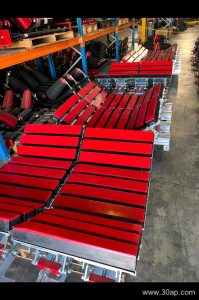
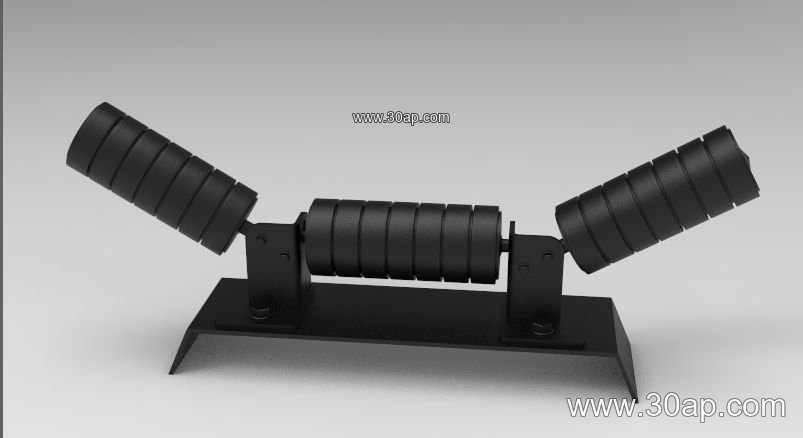
An impact idler is the resilient roller set placed directly under the point where material drops onto a conveyor belt. Instead of a rigid steel shell, it carries rubber rings or a rubber-covered surface that absorbs the energy of falling lump material. In a quarry, a coal preparation plant or a cement plant, the difference between a standard carrying idler and an impact idler at the chute is usually measured in belt life. The same roller under a crusher discharge may see stone at several metres per second; a plain troughing idler would transfer that shock straight into the belt carcass and the frame.
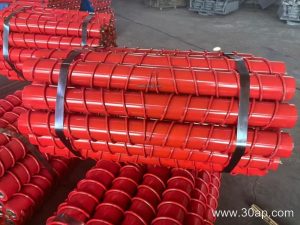
The product is also described as a buffer idler or shock-absorbing idler, and the rubber-ring version is often called a rubber ring buffer idler. These names refer to the same component, so a buyer comparing quotations should check the construction rather than the label.
Construction Details That Matter
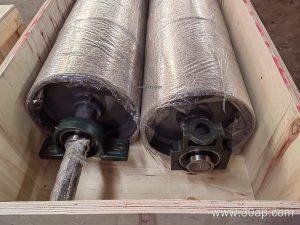
A typical impact idler uses a heavy-gauge steel tube as the base, with a stack of rubber rings pressed onto it, or a bonded rubber sleeve. The rings are spaced so that fines can fall away rather than pack between them. Bearings are usually sealed deep-groove ball bearings — 6205, 6305 or 6306 appear often in medium sizes — set in a housing with labyrinth or contact seals. The shaft ends fit into the conveyor bracket, and the whole set is mounted in a three-roll troughing arrangement at the transfer point.
- Roll surface options: rubber ring, rubber sleeve, and in lighter duties plain steel or nylon
- Common roll diameters: Ø89, Ø108, Ø127, Ø133, Ø159 and Ø178 mm
- Trough angles: 20, 30, 35 and 45 degrees, with 35 degrees frequent at loading stations
- Belt widths served: B500 through B2000, with wider frames available on request
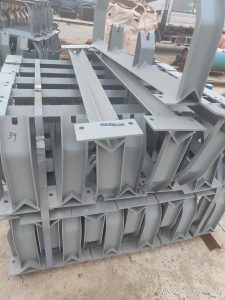
The frame under an impact idler is often reinforced, because the set must resist both the static weight of the belt and the dynamic load of the falling stream. A common mistake is to fit buffer rollers into a standard frame designed for lighter carrying idlers.
Where Buffer Rollers Are Used
The main applications are transfer points in crushing and screening circuits, run-of-mine discharge in iron ore and copper ore operations, coal handling in power plants, and clinker or limestone handling in cement works. In a sand and aggregate line, the roller sits just below the crusher conveyor belt discharge. In a ship loading or port terminal, it protects the belt where the loading chute delivers bulk material. The same logic applies to a steel plant conveyor handling sinter or coke.
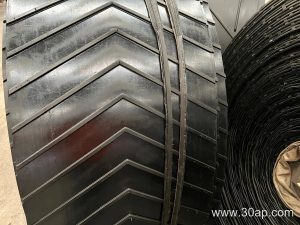
Selection should follow the duty. A high abrasion resistant conveyor belt may tolerate the wear at a transfer point, but the carcass still needs cushioning against sharp lump impact. Where the conveyed material is hot, a heat resistant conveyor belt may be needed and the rubber rings should be specified accordingly. In underground coal mining, a flame retardant conveyor belt is normally required, and the impact idler rubber should be compatible with that fire resistant specification.
Roll Diameter, Belt Width and Roll Length
Roll diameter is chosen from the belt width, the lump size and the drop height, not from the belt width alone. A B800 frame may use Ø89 or Ø108 mm rolls depending on load; a B1400 frame at a primary crusher discharge often moves to Ø133 or Ø159 mm. The table below gives common reference values for three-roll troughing sets; side rolls and centre rolls can differ, and the final length is fixed by the frame design.
| Belt width | Typical roll diameter | Common roll length (three-roll trough) |
|---|---|---|
| B500 | Ø63 – Ø89 mm | about 200 mm |
| B650 | Ø76 – Ø108 mm | about 250 mm |
| B800 | Ø89 – Ø108 mm | about 315 mm |
| B1000 | Ø108 – Ø133 mm | about 380 mm |
| B1200 | Ø108 – Ø159 mm | about 465 mm |
| B1400 | Ø133 – Ø159 mm | about 530 mm |
| B1600 | Ø133 – Ø178 mm | about 600 mm |
| B1800 | Ø159 – Ø178 mm | about 670 mm |
| B2000 | Ø159 – Ø194 mm | about 750 mm |
These are reference ranges, not fixed pairings. The bearing size, shaft diameter and ring hardness are set by the load calculation. Do not derive a shaft size from belt width alone.
Buying Checklist
- State the drop height, lump size and throughput, not only the belt width.
- Confirm whether the frame is a reinforced impact frame or a standard troughing frame.
- Ask for the rubber hardness and ring thickness; softer rings cushion more but wear faster.
- Check seal type and bearing number, since dusty transfer points punish poor sealing.
- Match the roller to the belt: an EP conveyor belt, a steel cord conveyor belt or a multi-ply fabric core conveyor belt each behaves differently under point loading.
- For coal or underground work, confirm the flame retardant conveyor belt specification and keep the roller rubber consistent with it.
Well-chosen buffer rollers at the chute reduce belt edge damage and carcass fatigue, and they protect the conveyor pulley and conveyor bracket downstream from vibration. For anyone sourcing conveyor components, the impact idler is one of the cheapest places to prevent an expensive belt failure.