What a Belt Conveyor Trough Idler Does
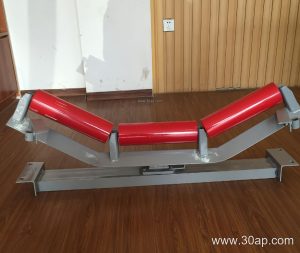
A belt conveyor trough idler is the carrying-side roller assembly that supports the loaded conveyor belt and shapes it into a trough. The three-roll arrangement lifts the belt edges so bulk material sits in a cradle instead of spilling over the sides. In a quarry, a limestone mine, or a cement plant feed line, this seemingly simple component determines how well the belt tracks, how much material escapes at transfer points, and how long the belt itself lasts.
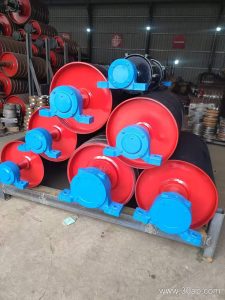
The same assembly is often called a troughing idler or troughing roller set. Those names refer to the same product; the trough idler is not a return roller, and it is not a conveyor pulley. Drive, tail, and bend pulleys do different work at the ends and curves of the conveyor, while the trough idler works continuously along the carrying run.
How the Assembly Is Built
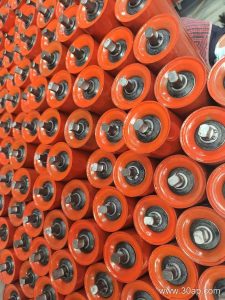
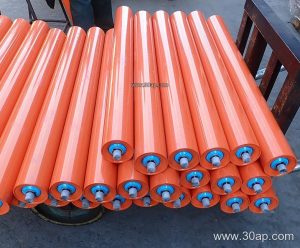
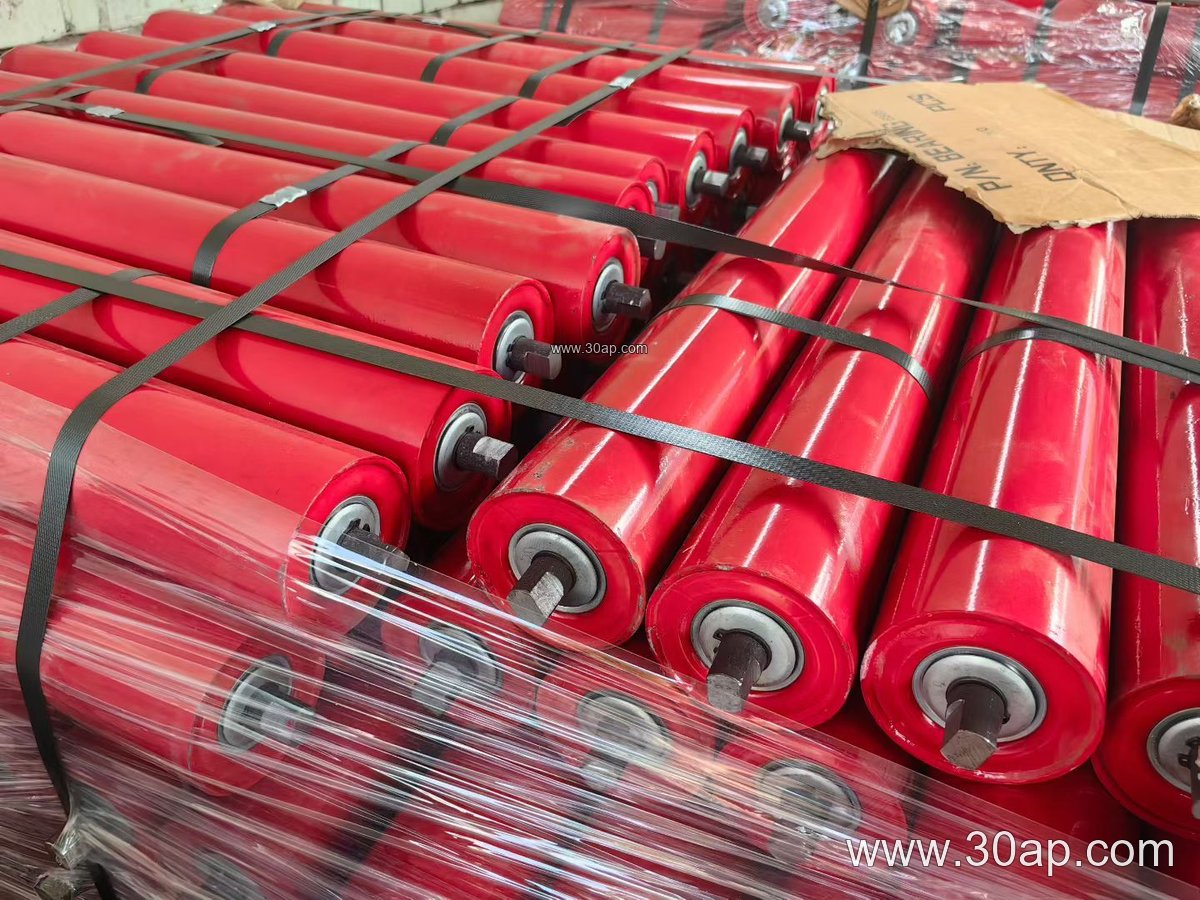
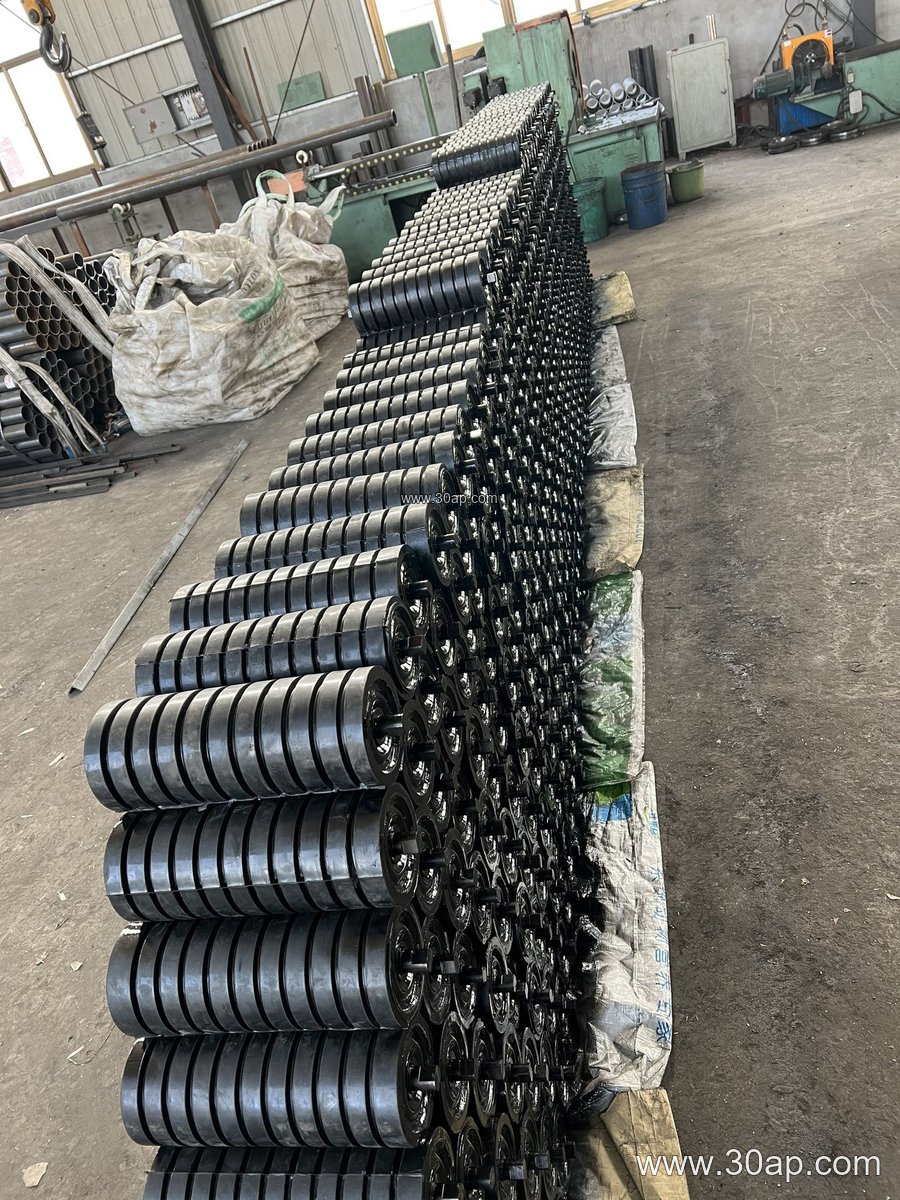
A typical set has two side rollers angled upward and one horizontal center roller, mounted in a steel frame that bolts to the conveyor bracket. Roller shells are usually steel tube, with nylon, ceramic, or rubber-ring surfaces available for specific duties. Sealed bearings keep dust out, and bearing numbers such as 6204, 6205, 6305, 6306, 6308, and 6310 appear across the range. A given bearing size is not tied to one roller diameter, so buyers should confirm the actual bearing fit rather than assume it from the shell size.
- Roller diameter: commonly Ø63, Ø76, Ø89, Ø102, Ø108, Ø127, Ø133, Ø159, Ø178, Ø194, or Ø219 mm
- Trough angle: 20, 30, 35, or 45 degrees
- Roller length: matched to belt width and frame geometry
- Surface options: steel, nylon, ceramic, rubber rings
Forward lean of about 1.5 to 2 degrees is sometimes built into the side rollers to help center the belt, but it is a design choice rather than a universal feature.
Matching Roller Length to Belt Width
Roller length follows belt width, trough angle, and the number of rolls in the set. The figures below are common reference examples, not fixed pairings. Side rollers and the center roller can differ, and a wide belt may use a different frame than a narrow one with the same trough angle.
| Belt width | Typical three-roll center roller length |
|---|---|
| B500 | about 200 mm |
| B650 | about 250 mm |
| B800 | about 315 mm |
| B1000 | about 380 mm |
| B1200 | about 465 mm |
| B1400 | about 530 mm |
| B1600 | about 600 mm |
| B1800 | about 670 mm |
| B2000 | about 750 mm |
Belt width itself ranges widely, from B400 and B500 up through B2400 in heavy bulk systems. A 1200mm wide conveyor belt and a 1800mm wide conveyor belt will not share the same idler set, and a steel cord conveyor belt may call for a sturdier frame than a fabric core conveyor belt of the same width.
Where Trough Idlers Matter Most
In a coal washing plant or a power station coal yard, dust and fines are constant, so sealing quality matters as much as shell thickness. In an iron ore or copper ore transfer line, impact at the loading point is severe, and a rubber-ring impact idler may be placed just downstream of the chute before standard troughing sets take over. Aggregate plants and stone crushing lines often run abrasive material, making abrasion resistant roller surfaces worth discussing with the supplier.
The belt itself should be considered together with the idler. A flame retardant conveyor belt for underground coal mining, a heat resistant conveyor belt near a clinker cooler, or an oil resistant conveyor belt in a recycling line all place different demands on the rollers beneath them.
What Buyers Should Confirm
Before ordering, confirm belt width, trough angle, roller diameter, roller length, and the mounting hole pattern on the existing conveyor bracket. Ask whether the frame is a single-roll, two-roll, or three-roll troughing set, and whether transition idlers are needed where the belt changes angle near a pulley. Check the bearing designation and seal type, and state the operating environment clearly, since a quarry, a fertilizer plant, and a port ship loader each expose rollers to different conditions.
Spare parts planning also deserves attention. Keeping a small stock of complete trough idler sets, rather than loose rollers, shortens downtime when a bearing seizes. Inspectors should watch for a stopped roller, a worn shell, or material build-up on the frame, because a dragging idler can damage the conveyor belt and increase motor load. None of these checks require special tools, but they do require a routine.
Used with the right belt and maintained sensibly, a belt conveyor trough idler is one of the least expensive parts of a bulk handling line and one of the most influential.