What a Conveyor Pulley Does on a Belt System
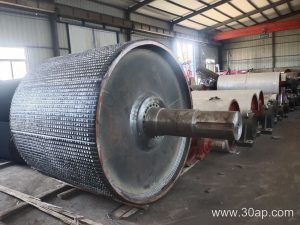
A conveyor pulley is the rotating cylindrical assembly that drives, redirects or tensions a conveyor belt. On a quarry face, in a coal washing plant, at a cement clinker line or inside a power station coal yard, this component transfers motion and keeps the belt tracking around the circuit. It differs from a carrying idler roller because it transmits torque or changes belt direction under load, rather than simply supporting the belt between stations. The same product is also called a drum pulley or belt pulley in many workshops, and those terms refer to the same item.
Main Subtypes and Where They Sit
Position and duty define the subtype. A drive pulley, also called the head or drive drum, is connected to the gearbox and pulls the loaded belt. A tail pulley sits at the opposite end and returns the belt. A bend pulley changes direction without driving or tensioning. A tension pulley takes up slack, while a snub pulley increases wrap angle at the drive. These roles are not interchangeable. A bend pulley cannot replace a drive pulley, and a tail pulley is not a tension pulley, even though all of them may look similar from the outside.
Construction and Surface Options
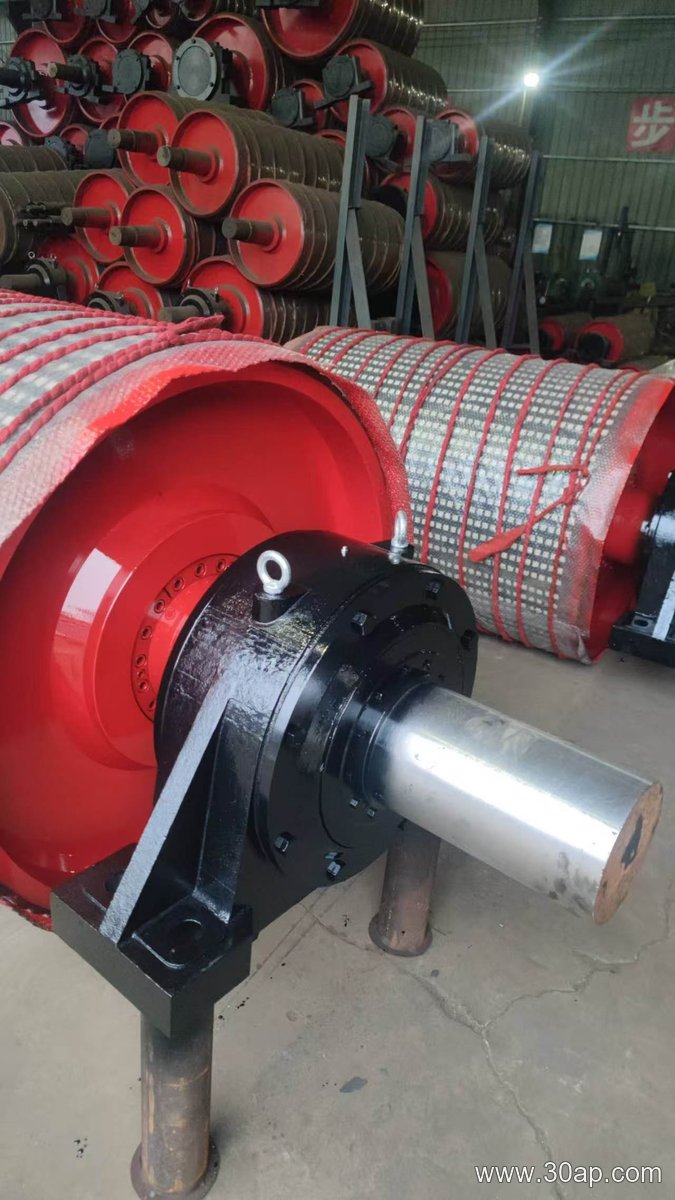
The shell is usually a seamless steel tube or rolled plate, machined at both ends and welded to the hubs. The shaft is sized by torque and bending load, not by belt width alone. Common shaft diameters include Ø50, Ø60, Ø70, Ø80, Ø90, Ø100, Ø120, Ø140, Ø160, Ø180 and Ø200 mm. Bearings sit in pillow blocks that bolt to the conveyor bracket, and the whole assembly is aligned to the belt centerline.
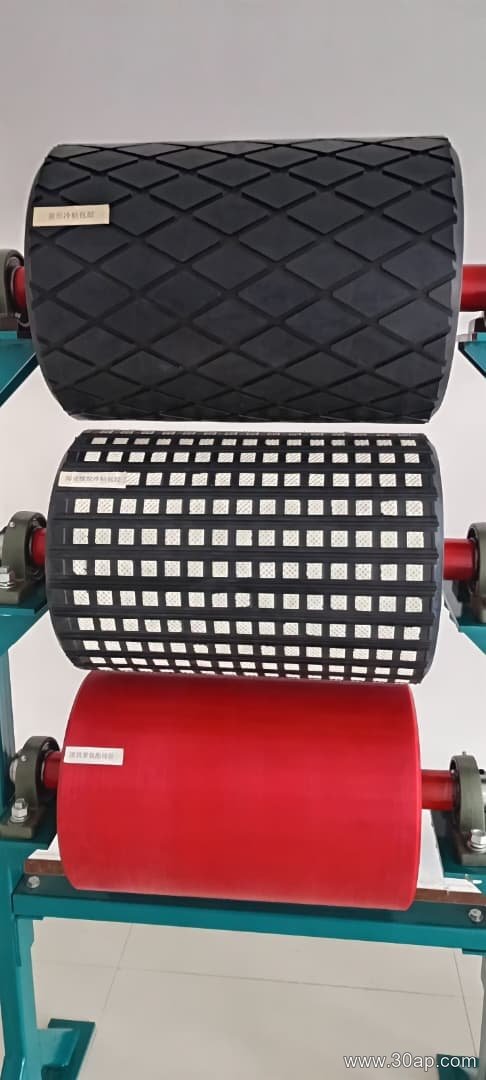
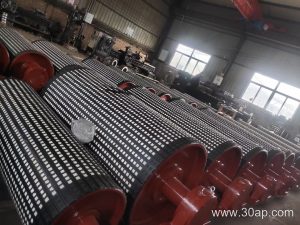
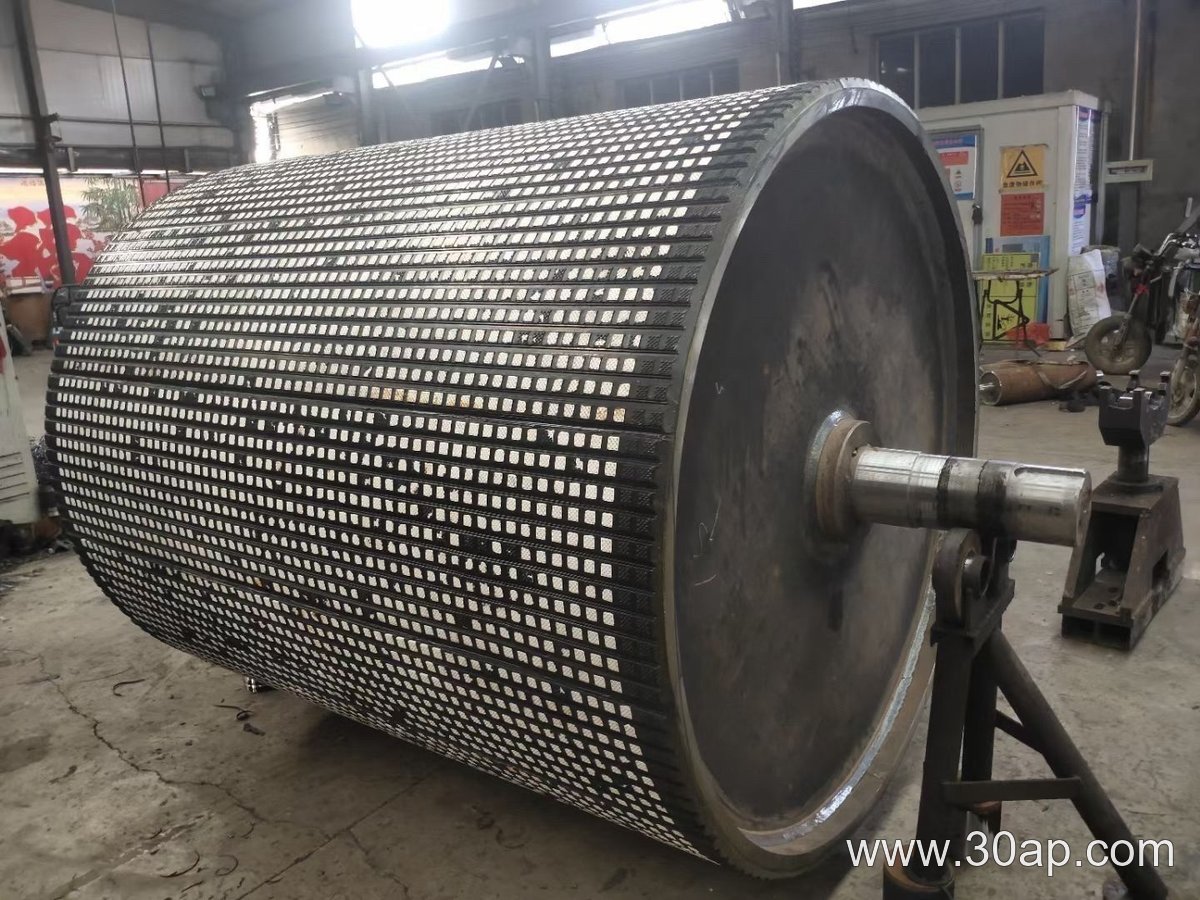
Surface treatment affects grip and wear life. Smooth or plain face is used where slip is not a concern. Rubber lagging, applied by hot vulcanizing, cold bonding or casting, improves friction and protects the shell. Diamond, herringbone and ceramic lagging patterns are chosen for wet, dusty or high-torque duties. Lagging thickness is commonly 8, 10, 12, 15 or 20 mm depending on the application.
Typical Sizes and Combinations
Diameter and face width are selected together with belt width and load. The table below shows reference combinations that appear in general design practice; actual values are always confirmed by the conveyor designer.
| Belt width | Typical pulley face width | Example diameter | Common shaft range |
|---|---|---|---|
| B400 | about 500 mm | Ø200 – Ø315 | Ø50 – Ø80 |
| B500 | about 600 mm | Ø250 – Ø400 | Ø60 – Ø90 |
| B650 | about 750 mm | Ø315 – Ø500 | Ø70 – Ø100 |
| B800 | about 950 mm | Ø400 – Ø630 | Ø80 – Ø120 |
| B1000 | about 1150 mm | Ø500 – Ø800 | Ø90 – Ø140 |
| B1200 | about 1400 mm | Ø630 – Ø1000 | Ø100 – Ø160 |
| B1400 | about 1600 mm | Ø800 – Ø1250 | Ø120 – Ø180 |
| B1600 | about 1800 mm | Ø1000 – Ø1400 | Ø140 – Ø200 |
| B1800 | about 2000 mm | Ø1250 – Ø1600 | Ø160 – Ø200 |
| B2000 | about 2200 mm | Ø1400 – Ø1800 | Ø180 – Ø200 |
These are reference ranges, not fixed matches. A B1200 belt may run with a Ø1000 drive pulley in one plant and a different diameter in another, depending on belt speed, tension and available space. A combination such as B800 × Ø500 or B1400 × Ø800 appears in many layouts, but it is not a rule. The face width is normally slightly larger than the belt width to allow for mistracking.
Where They Are Used
In a limestone quarry, a heavy drive pulley with diamond lagging handles coarse rock from the primary crusher. In a coal preparation plant, a bend pulley redirects the belt around a transfer tower, while a tension pulley keeps the return strand tight. Cement plants use smooth-faced tail pulleys on clinker lines where abrasive dust is present. Power stations rely on lagged head pulleys to move coal from stockpile to boiler bunker. The equipment name changes with the duty, but the working principle stays the same.
What Buyers Should Check Before Ordering
- Confirm the duty: drive, tail, bend, tension or snub. State the position clearly in the inquiry.
- Provide belt width, belt speed, motor power and required tension so the shaft and shell can be calculated.
- Specify lagging type and thickness if grip or wear protection matters.
- Check shaft diameter and bearing size against the actual torque load, not just the belt width.
- Verify face width, bolt pattern and conveyor bracket dimensions to avoid fitting problems on site.
- Ask for the balancing grade and runout tolerance if the pulley will run at high speed.
Maintenance is mostly about alignment, bearing lubrication and lagging inspection. Worn lagging reduces grip and can cause belt slip, especially in wet conditions. A damaged shell or bent shaft will affect tracking and shorten belt life. Replacing a worn pulley with the correct subtype and size is safer than adapting a different unit.
Summary
A conveyor pulley is a load-bearing, torque-transferring component, not a simple roller. Choosing the right subtype, diameter, face width, shaft size and surface treatment keeps a conveyor belt running smoothly in mining, quarrying, cement, power and bulk handling operations. The key is to match the pulley to the duty and the belt, and to confirm every dimension with the conveyor designer before production.