What Is a Terminal Conveyor Pulley
A terminal conveyor pulley is a large rotating drum positioned at the head or tail end of a belt conveyor. Its primary job is to redirect the conveyor belt and, in many cases, to drive or tension the belt loop. Unlike drive pulleys that transmit power or bend pulleys that change belt direction mid-run, the terminal pulley sits at the extreme ends of the conveyor structure. In a quarry or a coal mining operation, you will often see one at the discharge point and another at the take-up end. The term is sometimes used interchangeably with head pulley or tail pulley, but strictly speaking, a terminal pulley refers to either end-of-line drum, and its exact role depends on the conveyor layout. This article explains how these pulleys are built, where they are used, and what to check before ordering.
Construction and Key Components
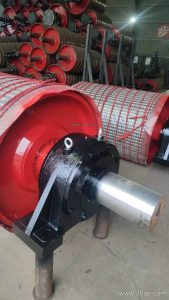
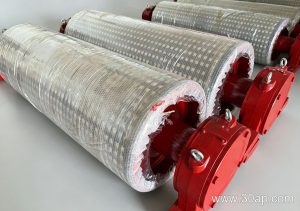
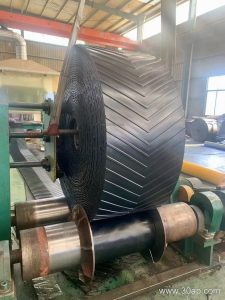
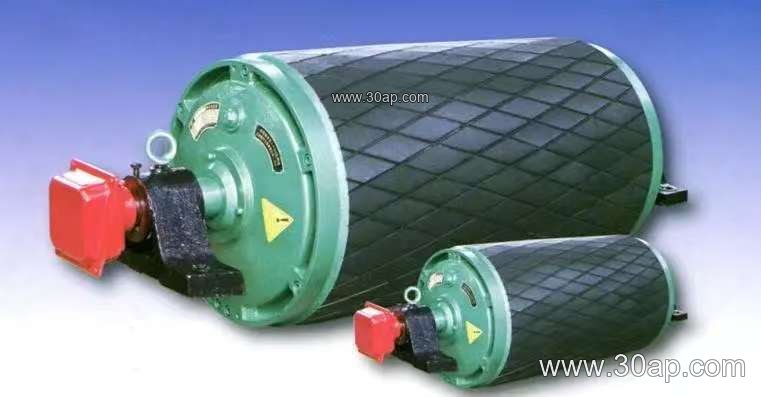
A terminal conveyor pulley typically consists of a cylindrical shell, two end discs, a shaft, and a bearing housing on each side. The shell is usually made from seamless steel tube or rolled steel plate, machined to ensure concentricity. The shaft is sized according to torque and radial load, not simply by belt width. Common shaft diameters range from Ø50 to Ø200 mm, but the final value must be calculated from the actual conveyor duty. Bearings are mounted in pillow blocks or flanged housings that bolt to the conveyor bracket. Surface treatment is a critical choice: plain steel, rubber lagging (cold-bonded or hot-vulcanized), diamond grooved lagging, chevron lagging, or ceramic lagging. Lagging thickness commonly falls between 8 mm and 20 mm. The pulley face width is usually slightly wider than the belt; for example, a B800 belt often pairs with a 950 mm face width, and a B1200 belt with about 1400 mm. However, these are reference examples, not fixed rules. The terminal pulley must be balanced and machined to avoid belt tracking problems.
Where Terminal Conveyor Pulleys Are Used
These pulleys appear in almost every bulk material handling system. In a limestone quarry, the terminal pulley at the crusher discharge often runs under wet, abrasive conditions, so abrasion resistant conveyor belt and lagged pulleys are common. In a coal mining operation, flame retardant conveyor belt and anti-static properties are essential, and the terminal pulley may be specified with a rubber lagging that meets underground safety requirements. Cement plants use them at the clinker cooler and at the transfer points to the silo, where heat resistant conveyor belt may be needed. Power plants handling coal rely on terminal pulleys at the head end of the coal conveyor, often combined with a heavy-duty mining conveyor belt. Port bulk terminals use large terminal pulleys on ship loading conveyors, where wide belts such as 1800 mm or 2000 mm are not unusual. The same principle applies in sand and aggregate lines, steel plants, and fertilizer handling. In each case, the terminal pulley works together with the conveyor belt, idler roller, and conveyor bracket to keep the system running smoothly.
Matching the Pulley to the Belt and Application
Selecting a terminal conveyor pulley is not just about diameter. The belt type influences lagging choice and pulley design. For a steel cord conveyor belt, the pulley diameter must be large enough to limit bending stress on the cords; common combinations include B1200 with Ø1000 mm or B1400 with Ø800 mm, but the exact ratio depends on the belt manufacturer’s recommendation. For fabric core belts such as EP conveyor belt or NN conveyor belt, smaller diameters may be acceptable. Abrasion resistant conveyor belt in a quarry may call for ceramic lagging to extend pulley life, while a heat resistant conveyor belt in a cement plant may need a heat-tolerant lagging compound. In underground coal mining, the terminal pulley should be designed to avoid static buildup and may be paired with a PVG conveyor belt. The table below gives typical reference sizes, but these are not mandatory combinations.
| Belt Width (mm) | Typical Pulley Face Width (mm) | Common Pulley Diameter Range (mm) | Common Shaft Diameter Range (mm) |
|---|---|---|---|
| B500 | 600 | Ø250–Ø400 | Ø50–Ø80 |
| B650 | 750 | Ø315–Ø500 | Ø60–Ø100 |
| B800 | 950 | Ø400–Ø630 | Ø70–Ø120 |
| B1000 | 1150 | Ø500–Ø800 | Ø80–Ø140 |
| B1200 | 1400 | Ø630–Ø1000 | Ø90–Ø160 |
| B1400 | 1600 | Ø800–Ø1250 | Ø100–Ø180 |
| B1600 | 1800 | Ø1000–Ø1400 | Ø120–Ø200 |
| B1800 | 2000 | Ø1250–Ø1600 | Ø140–Ø200 |
Always confirm the shaft diameter by torque calculation. Do not assume that a given belt width automatically dictates a specific shaft size.
Buyer Checklist for Terminal Conveyor Pulleys
- Define the pulley’s role: head end, tail end, or tensioning position. A terminal pulley at the head may be a drive pulley, while at the tail it may be a bend or take-up pulley.
- Specify the belt width and type, such as EP200 conveyor belt, steel cord ST1600 conveyor belt, or abrasion resistant conveyor belt. This affects lagging and diameter limits.
- Choose the lagging surface: plain, rubber, diamond, chevron, or ceramic. Consider material abrasiveness, moisture, and temperature.
- Provide the required face width, typically belt width plus 100–200 mm, but verify with the conveyor design.
- State the shaft diameter and bearing type based on load calculations, not guesswork.
- Confirm the mounting dimensions with the conveyor bracket and the available space.
- For underground coal mining, request flame retardant and anti-static properties for both belt and lagging.
Maintenance and Troubleshooting
Even a well-built terminal conveyor pulley needs attention. Check lagging wear regularly, especially in high-abrasion service like iron ore or copper ore handling. Worn lagging reduces traction and can cause belt slip. Inspect bearings for noise or overheating, and verify that the pulley remains aligned with the conveyor frame. Belt tracking problems often trace back to a misaligned terminal pulley or uneven lagging. Keep the area around the pulley clean; material build-up on the shell can damage the belt. When replacing a pulley, match the new unit’s face width and shaft size to the original design, and recheck belt tension. A terminal pulley that runs true will extend the life of the conveyor belt and reduce downtime in any quarry, mine, or plant.