What a Ceramic Pulley Is
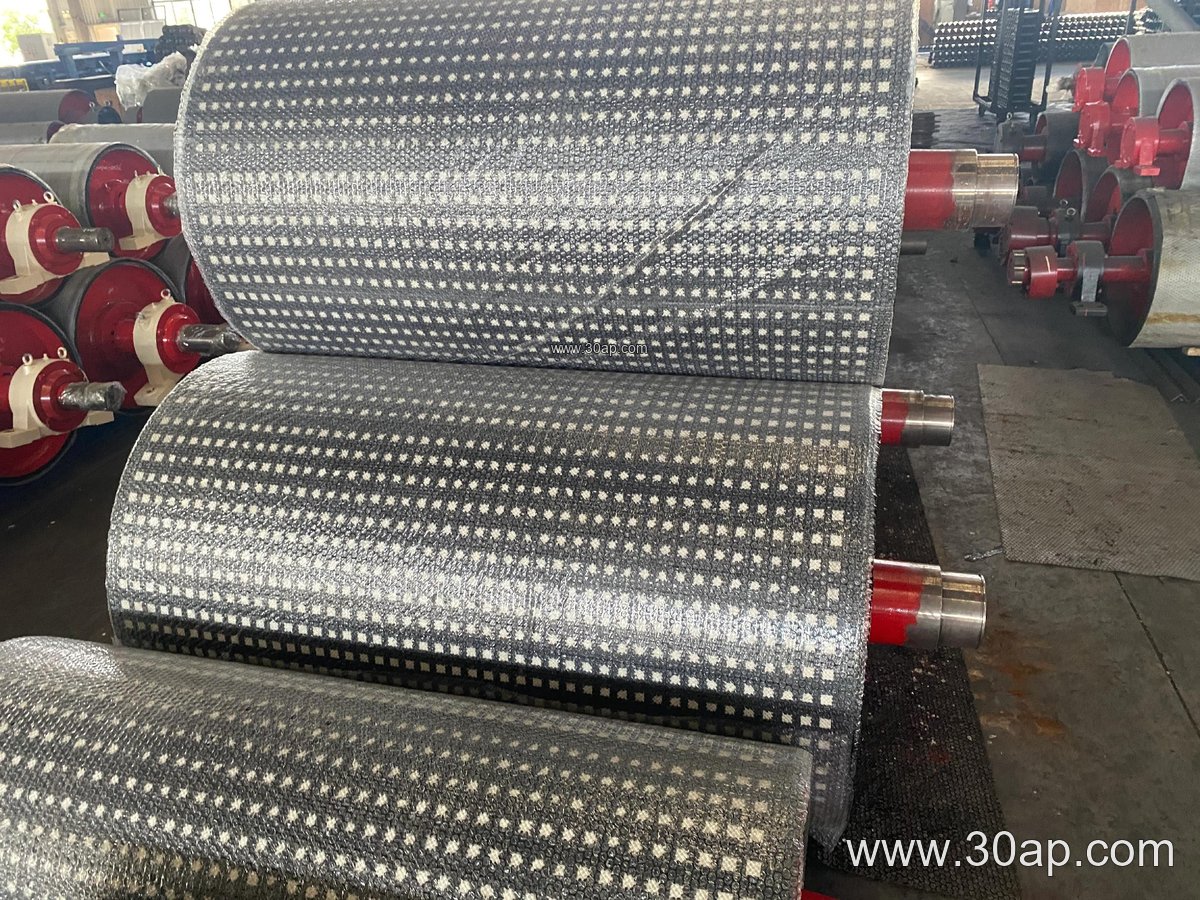
A ceramic pulley is a conveyor pulley whose shell is covered with ceramic lagging instead of plain rubber or bare steel. The ceramic tiles, usually embedded in a rubber or epoxy backing, give the drum face a hard, gritty texture. That texture raises friction between the shell and the belt, which matters most where traction is marginal. In practice, the ceramic pulley is a lagged drum, and many buyers treat “ceramic lagging pulley” and “ceramic pulley” as the same item.
It is still a conveyor pulley, so it keeps the usual duties of carrying the belt, setting its path, and transmitting torque. The ceramic layer only changes the contact surface, not the drum’s role. A drive pulley with ceramic lagging still pulls the belt; a bend pulley with the same covering still redirects it.
How the Ceramic Cover Is Built
A typical shell starts as a rolled steel cylinder with welded end discs and a shaft, then receives the lagging. Ceramic tiles are set in a pattern with small gaps so water and fines can escape rather than sit under the belt. Tile shapes and spacing vary by maker, and some designs use raised studs or grooves. Bonding may be vulcanized, cold-bonded, or cast into a polymer layer.
Common lagging thicknesses are 8, 10, 12, 15, and 20 mm, with the ceramic layer often specified separately from the backing. The shell face is normally wider than the belt, for example B800 with roughly 950 mm face width or B1200 with about 1400 mm. Diameters commonly run from Ø200 up to Ø1250 and beyond on large drives, and shaft sizes from Ø50 to Ø200 are typical, chosen by torque and load rather than by belt width alone.
| Parameter | Common reference values |
|---|---|
| Belt width | B400, B500, B650, B800, B1000, B1200, B1400, B1600, B1800 |
| Pulley diameter | Ø200, Ø250, Ø315, Ø400, Ø500, Ø630, Ø800, Ø1000, Ø1250 |
| Lagging thickness | 8, 10, 12, 15, 20 mm |
| Shaft diameter | Ø50, Ø60, Ø70, Ø80, Ø90, Ø100, Ø120, Ø140, Ø160 |
| Cover style | Ceramic lagging, diamond rubber, plain rubber, bare steel |
Where It Fits on the Conveyor
Ceramic lagging is most often chosen for drive pulleys and head pulleys, where slip would cost throughput. It also appears on tail pulleys in wet or muddy conditions and on tension pulleys that must hold grip while the take-up moves. On a long overland line in a quarry or a coal mining conveyor, the drive drum is the usual first candidate.
Placement changes the requirement. A bend pulley only redirects the belt and may not need ceramic at all, while a drive pulley with a low wrap angle benefits most from the extra friction. Do not swap these positions in a specification: drive, tail, and bend pulleys are different duties, and the ceramic option should be tied to the actual station.
Ceramic lagging suits abrasive and wet service, such as limestone, iron ore, copper ore, and clinker lines, and it can be paired with an abrasion resistant conveyor belt or a heat resistant conveyor belt where temperatures allow. It is less attractive where the belt back is delicate, such as some food grade or thin fabric core belts, because the hard surface can wear the cover.
Matching the Pulley to the Belt
The belt and the drum work as a pair. A heavy-duty mining conveyor belt with a thick cover tolerates a coarse ceramic face, while a light EP conveyor belt or NN conveyor belt may need a finer tile pattern. Belt stiffness affects the minimum drum diameter, so a steel cord conveyor belt generally calls for a larger diameter than a multi-ply fabric core belt of the same width.
At china-conveyor-belt.com we see enquiries that pair a ceramic pulley with an EP conveyor belt, a steel cord conveyor belt, or a flame retardant conveyor belt for underground coal mining. The pulley data and the belt data should be reviewed together, since wrap angle, belt tension, and lagging pattern all influence grip.
Buyer Checklist
- Confirm the station: drive, tail, tension, or bend. The ceramic cover is not a universal upgrade for every drum.
- State belt width and type, for example B1000 with an EP conveyor belt or B1400 with a steel cord belt.
- Give the required diameter and shaft size from the conveyor design, not from a width table.
- Specify lagging thickness and tile pattern, and ask how tiles are bonded.
- Check that the pulley face width, brackets, and bearing housings fit the existing conveyor bracket and frame.
- Plan inspection: chipped tiles and worn backing reduce grip before the drum itself fails.
Ceramic lagging is a wear part as much as a traction aid, so spare coverage and a realistic replacement interval belong in the purchase plan. Used well, a ceramic pulley keeps a conveyor driving in conditions where rubber alone would slip.