What a Welded Pulley Is
A welded pulley is a conveyor pulley whose shell, end discs, and hub assembly are joined by welding rather than by casting or bolting. In a belt conveyor, this component rotates with the belt and performs one of several duties: driving the belt, supporting it at the tail end, changing its direction, or maintaining tension. Buyers often meet the same product under the equivalent name welded conveyor pulley, and the two terms describe one item. A drive pulley, a tail pulley, and a bend pulley are distinct positions in the conveyor layout and are not interchangeable, even though all may be supplied as welded pulleys.
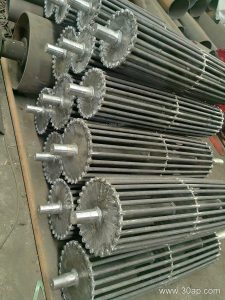
How the Welded Shell Is Built
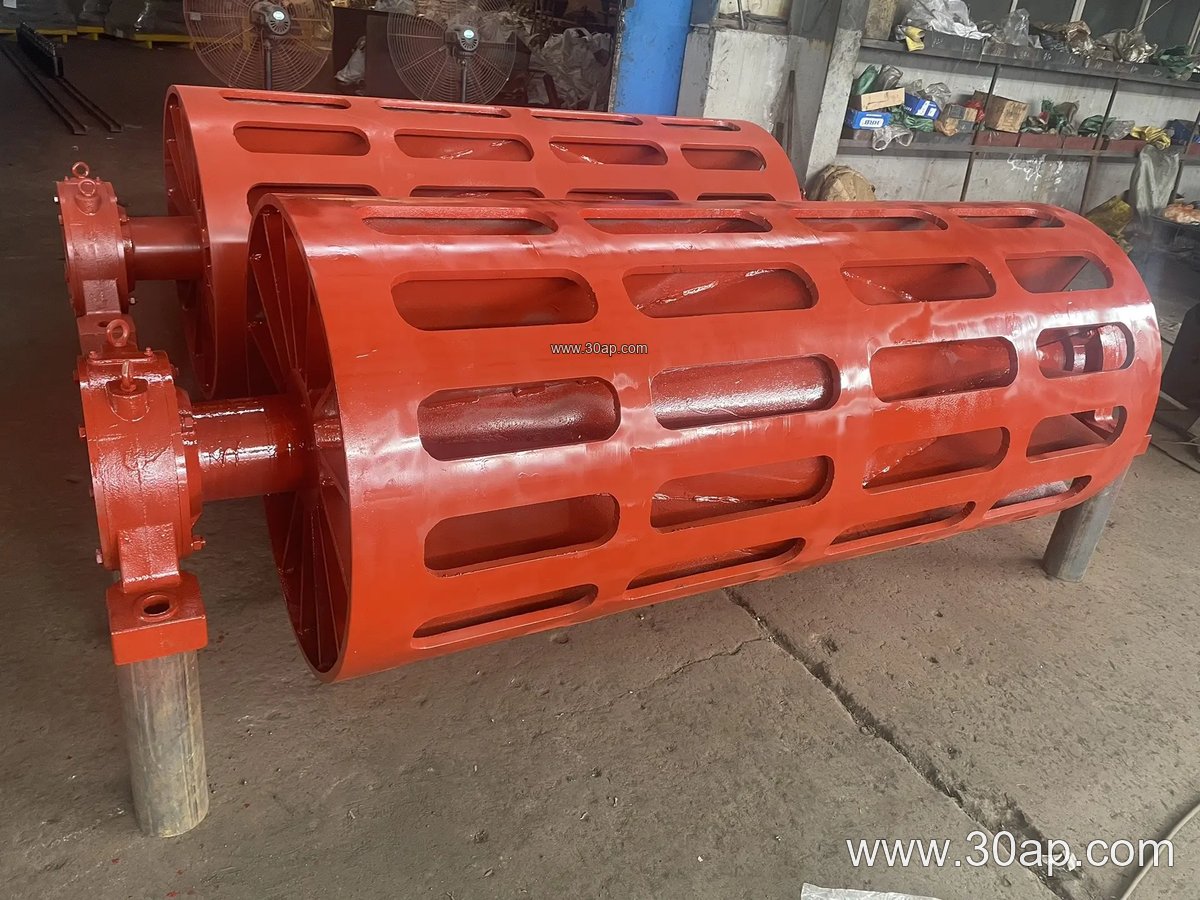
Production usually begins with a rolled steel shell, to which end discs are welded. The shaft is fitted through the hubs, and the assembly is machined so that the shell runs true. Because welding introduces heat, a controlled sequence and stress relief help keep the pulley round and balanced, which matters at higher belt speeds. The finished body can be left plain or covered with rubber or ceramic lagging to improve grip. A welded pulley is common in medium and heavy conveyor duty where a fabricated steel body offers a practical balance of strength, repairability, and lead time. The related conveyor pulley in a cast design may suit other duty profiles, but it is a different construction, not a substitute name.
Where Welded Pulleys Are Used
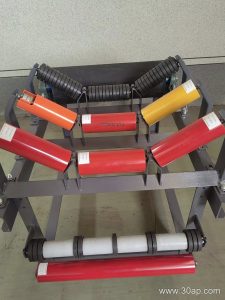
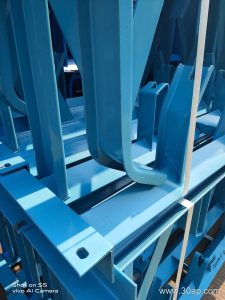
These pulleys appear across bulk handling: a limestone quarry feeding a crusher, a coal preparation plant moving washed product, a cement plant transferring clinker, or a power station coal yard. In each case the pulley works together with the belt, the conveyor idler roller, and the conveyor bracket that fixes the bearing housing to the frame. Drive positions demand good traction and torque transmission; tail positions tolerate a simpler surface; bend and take-up positions guide the belt around corners or hold tension. When specifying, state the position clearly so the supplier does not confuse a drive pulley with a bend pulley.
Matching Pulley Size to Belt Width
Shell width is normally a little wider than the belt. Common relationships include B400 with roughly 500 mm face, B500 with about 600 mm, B650 with about 750 mm, B800 with about 950 mm, B1000 with about 1150 mm, B1200 with about 1400 mm, and B1400 with about 1600 mm. Diameter is chosen from belt tension, wrap angle, and space, not from width alone. Typical combinations such as B800 × Ø500, B1200 × Ø1000, or B1400 × Ø800 show how the two dimensions vary independently. Shaft diameter follows torque and bearing load; common values run from Ø50 to Ø200, and no fixed shaft size should be assumed from belt width.
| Parameter | Common Reference Values |
|---|---|
| Belt width | B400, B500, B650, B800, B1000, B1200, B1400, B1600, B1800, B2000 |
| Pulley diameter | Ø200, Ø250, Ø315, Ø400, Ø500, Ø630, Ø800, Ø1000, Ø1250, Ø1400 |
| Lagging | Plain, cold-bonded rubber, hot vulcanized rubber, diamond groove, herringbone, ceramic |
| Lagging thickness | 8, 10, 12, 15, 20 mm |
| Shaft diameter | Ø50 to Ø200, sized by design load |
Surface Choice and Belt Compatibility
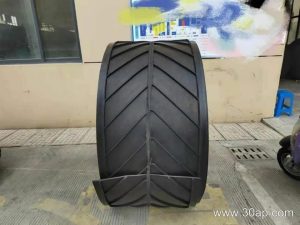
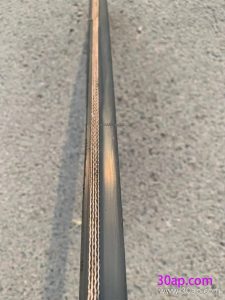
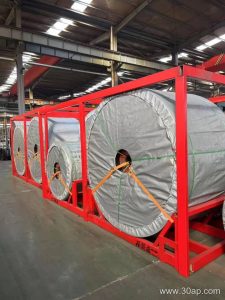
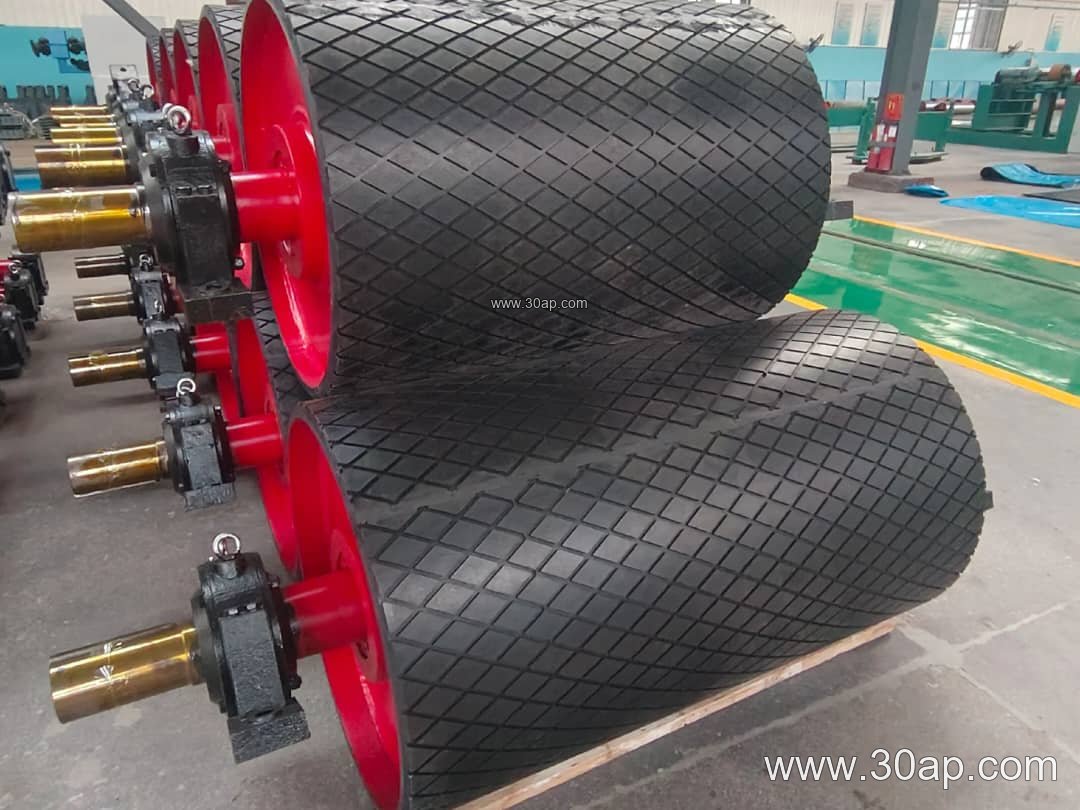
Lagging selection depends on the belt and the material. A diamond or herringbone rubber cover helps shed water and fines on a drive pulley in a wet quarry line. Ceramic lagging suits high-traction drives where slip is a concern. Plain faces are adequate for many bend and tail positions. The pulley must also suit the belt itself: a heavy-duty mining conveyor belt or an abrasion resistant conveyor belt carries different loads than a lightweight fabric core conveyor belt, and the pulley diameter should respect the belt’s minimum bend radius. In dusty coal handling, a flame retardant conveyor belt is often paired with lagging that does not retain combustible dust.
What Buyers Should Confirm
- Position in the conveyor: drive, tail, bend, take-up, or snub, stated explicitly.
- Belt width and required face width, plus pulley diameter and shaft size from the design.
- Lagging type and thickness, and whether balancing is required for the belt speed.
- Bearing type and the conveyor bracket interface, so the pulley fits the existing frame.
- Environmental conditions such as dust, moisture, temperature, and corrosion exposure.
Ask for a dimensioned drawing before approval, and check that the welded joints, machining tolerances, and dynamic balance are addressed. A well-specified welded pulley, matched to the belt and the conveyor idler roller layout, reduces belt tracking problems and extends service life in quarry, cement, and power plant service.