What a Conveyor Take-Up Pulley Does
A conveyor take-up pulley is the drum that maintains the correct tension in a conveyor belt. It is part of the take-up system, which may be gravity-operated or screw-operated, and it moves along a guided frame to compensate for belt stretch and load changes. Without a properly functioning take-up pulley, a conveyor belt can slip on the drive pulley, wander off its tracking, or fail to carry material at the required rate. In a quarry, cement plant, or power station coal yard, this component quietly keeps the whole line running smoothly. The take-up pulley is sometimes called a tension pulley, and it should not be confused with the drive pulley, tail pulley, or bend pulley, each of which has a distinct role.
Construction and Surface Options
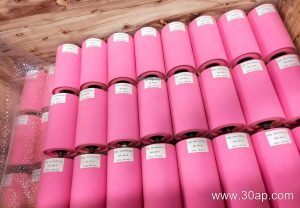
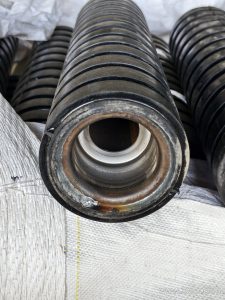
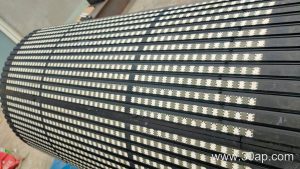
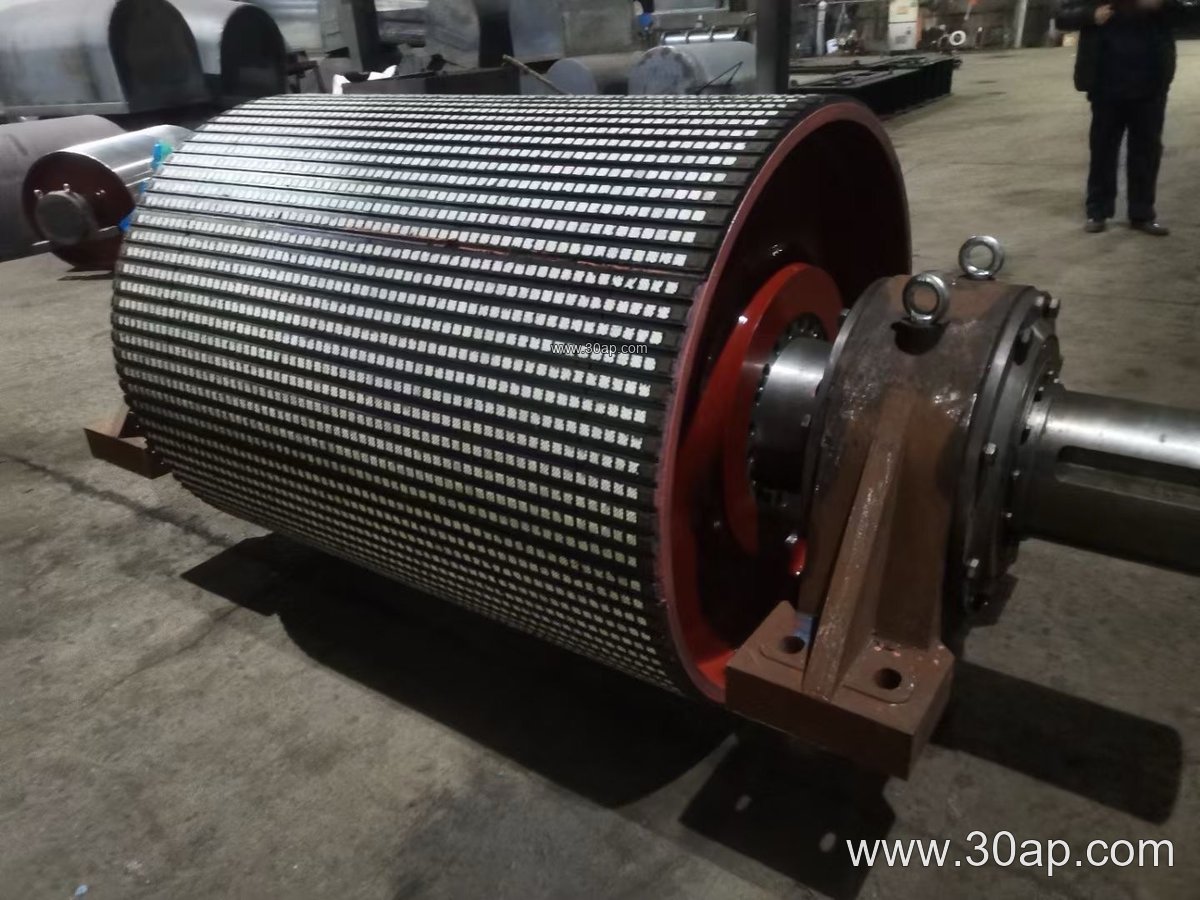
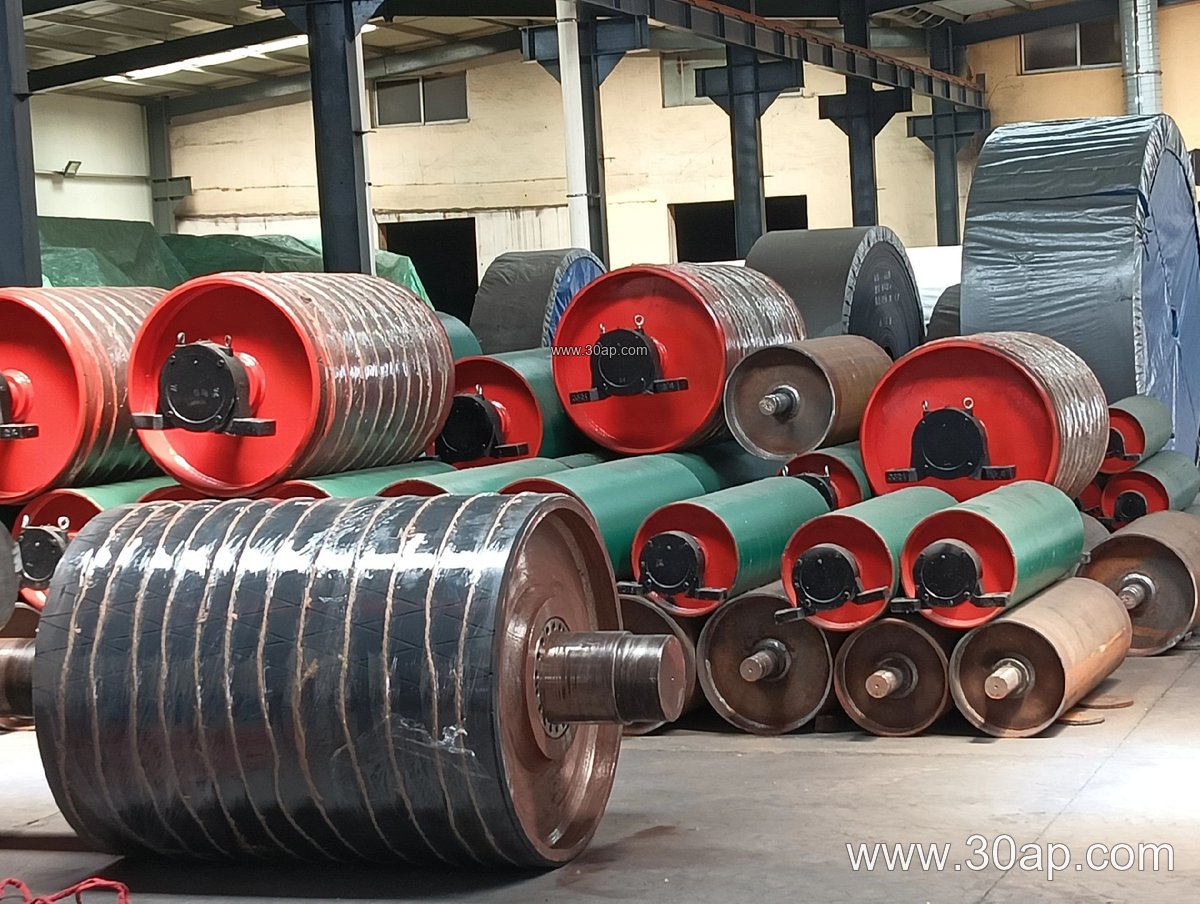
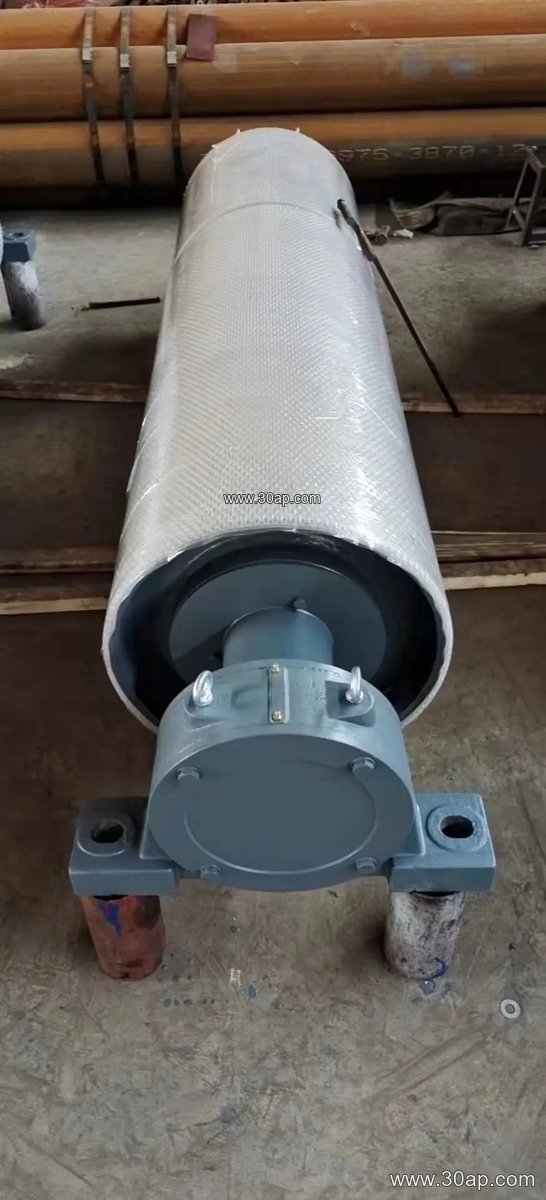
The take-up pulley is typically built with a steel shell, welded or cast hubs, and a shaft sized to the torque and load of the conveyor. The face width usually exceeds the belt width: for example, a B800 belt often runs on a pulley face of about 950 mm, while a B1200 belt might use a face around 1400 mm. Diameters for take-up pulleys commonly range from Ø200 to Ø1000, with larger sizes such as Ø1250 or Ø1400 used in heavy-duty mining and port applications. The surface may be plain, or covered with rubber lagging—cold-bonded, hot-vulcanized, diamond pattern, or ceramic—to improve grip and reduce belt wear. Lagging thickness is often 8, 10, 12, 15, or 20 mm, depending on the duty. Shaft diameters are not fixed by belt width alone; they are determined by torque and bearing load, with common sizes including Ø80, Ø100, Ø120, and Ø160.
Where It Is Used
Take-up pulleys appear in nearly every conveyor system that handles bulk material. In a limestone quarry, a gravity take-up pulley might sit on a vertical slide near the tail end, keeping tension on a rubber conveyor belt that carries crushed rock to the screening plant. In a coal-fired power plant, screw take-up pulleys are often found on shorter conveyors feeding the boiler bunkers, where space is limited. The same principle applies in a cement plant’s clinker line, a port’s ship-loading conveyor, and a sand and gravel operation. The take-up pulley works together with the conveyor belt, idler rollers, and conveyor brackets to maintain stable operation. It is not a substitute for a drive pulley or a tail pulley; rather, it is the tensioning element that keeps those components effective.
How to Match It to the Conveyor
Selecting a take-up pulley requires more than a single dimension. The belt width, belt type, and operating tension all influence the pulley diameter and shaft size. For a steel cord conveyor belt carrying iron ore, a larger diameter take-up pulley may be needed to reduce bending stress, while a fabric-core belt on a shorter aggregate conveyor might use a smaller drum. The take-up travel distance must also be considered; gravity systems need enough vertical drop to accommodate belt stretch, while screw systems need adequate screw length. Surface lagging should match the environment: a flame retardant conveyor belt in an underground coal mine may require a lagging that resists both wear and fire, whereas a food-grade line might need a smooth, cleanable surface. The table below lists common reference dimensions, but these are examples only, not fixed rules.
| Belt Width | Typical Pulley Face Width | Common Diameter Range | Typical Shaft Diameter Range |
|---|---|---|---|
| B500 | ≈600 mm | Ø200–Ø400 | Ø60–Ø100 |
| B650 | ≈750 mm | Ø250–Ø500 | Ø70–Ø120 |
| B800 | ≈950 mm | Ø315–Ø630 | Ø80–Ø140 |
| B1000 | ≈1150 mm | Ø400–Ø800 | Ø90–Ø160 |
| B1200 | ≈1400 mm | Ø500–Ø1000 | Ø100–Ø180 |
| B1400 | ≈1600 mm | Ø630–Ø1250 | Ø120–Ø200 |
| B1600 | ≈1800 mm | Ø800–Ø1400 | Ø140–Ø200 |
These combinations are indicative; final selection depends on the calculated tension, belt speed, and safety factor. A B1200 × Ø1000 take-up pulley is a common sight in heavy-duty mining, but a B1200 conveyor with a shorter run might use a Ø800 drum. Similarly, a B800 × Ø500 arrangement can work well in a small aggregate plant, while a B1400 × Ø800 pulley may suit a medium-duty cement conveyor.
Maintenance and Buyer Checks
Buyers should verify that the take-up pulley is supplied with the correct bearing housings, seals, and lagging specification. The pulley should be balanced for the intended belt speed, and the shaft should be machined to accept the chosen bearings without excessive play. Regular inspection of the lagging for wear, and of the take-up travel for sufficient adjustment range, helps prevent unexpected downtime. In dusty environments such as a quarry conveyor belt line or a coal handling system, sealed bearings and wear-resistant lagging can extend service life. It is also wise to confirm that the take-up pulley dimensions fit the existing conveyor brackets and that the take-up frame allows the required movement. When replacing a take-up pulley, match the original diameter and face width unless an engineering change has been approved, and always check that the new pulley is compatible with the belt’s tension requirements and the conveyor’s overall design.