What an EP100 Conveyor Belt Is
An EP100 conveyor belt is a fabric-reinforced rubber belt built on polyester warp and polyamide weft (EP) carcass plies, rated at 100 N/mm of belt width per ply in the reference strength system. In practice, the number is a nominal strength index, so the finished belt strength depends on the number of EP plies and the manufacturer’s construction. EP100 is the low end of the common EP range, which also includes EP200, EP315, EP400, EP500, EP630, EP800, EP1000, EP1250, EP1600 and EP2000. Buyers should read it as a starting point for light to medium duty, not as a universal specification.
How the Belt Is Built
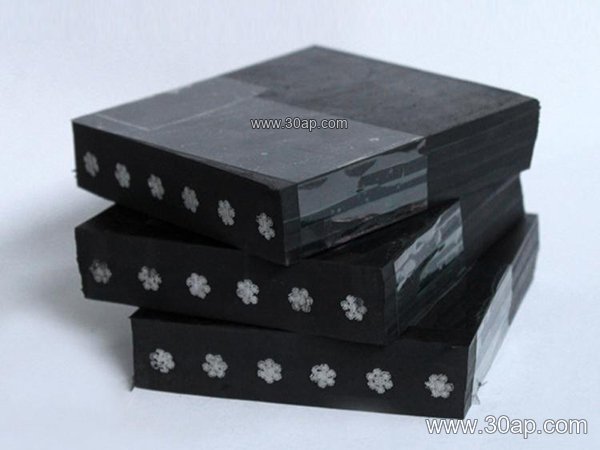
The carcass is the load-bearing component: usually 2 to 6 layers of EP fabric, bonded with skim rubber and protected by top and bottom cover compounds. Cover thickness is often written as a pair, for example 3+1.5 mm, 4+2 mm, 5+2 mm, 6+2 mm or 8+3 mm, where the first figure is the carrying side and the second the pulley side. The Grade 100 carcass is normally combined with covers selected for the duty: abrasion-resistant for limestone and clinker, heat-resistant for cement and sinter, oil-resistant for some coal and processing plants, flame-retardant and antistatic for underground coal mines, and cold-resistant or acid-alkali-resistant grades for exposed or chemical environments.
Where It Fits on a Conveyor
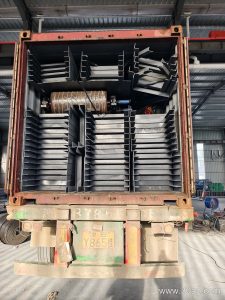
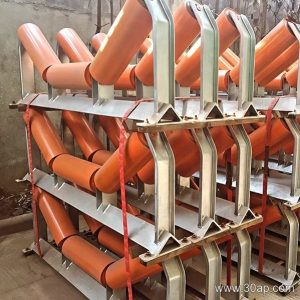
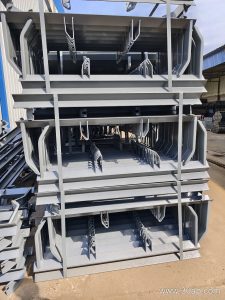
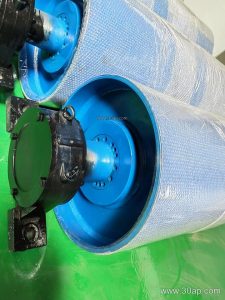
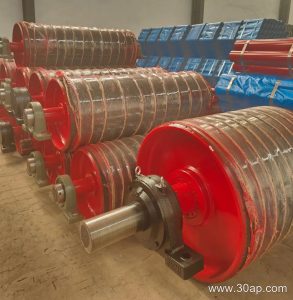
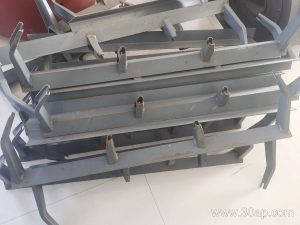
The belt runs over a drive pulley, a tail pulley and one or more bend pulleys, all supported by conveyor idler rollers and the conveyor frame with its conveyor brackets. Each pulley has a fixed role and cannot be swapped for another: the drive pulley transmits torque, the tail pulley returns the belt, and a bend pulley changes direction or adds wrap. EP100 is often seen in sand and gravel yards, cement plants, power station coal handling, and light-to-medium mine haulage where impact loads are moderate. In heavy primary crushing or long high-tension overland lines, higher-strength EP grades or steel cord belts are usually considered instead.
Common Dimensions and Construction Options
Belt width and cover thickness should follow the conveyor design, not the other way round. A few reference values that appear in catalogues are listed below; they are examples, not fixed pairings.
| Parameter | Reference values | Notes |
|---|---|---|
| Carcass strength | EP100 (also EP200 to EP2000) | Choose by calculated tension, safety factor and splice efficiency |
| Belt width | B500, B650, B800, B1000, B1200, B1400, B1600, B1800, B2000 | Match to lump size, capacity and pulley face width |
| Cover thickness | 3+1.5, 4+2, 5+2, 6+2, 8+3 mm | Top cover for wear, bottom cover for pulley contact |
| Ply count | Commonly 2 to 6 layers | Set by belt maker’s construction |
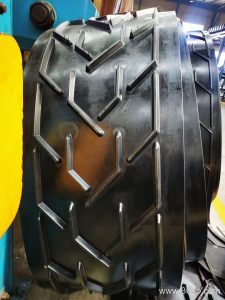
| Surface forms | Smooth, patterned, chevron, corrugated sidewall | Patterned and chevron help on inclines; sidewall for steep angles |
Width and pulley diameter are separate decisions: a B800 belt may run on different pulley sizes depending on tension and wrap angle. Do not assume a shaft diameter from belt width alone; that comes from the pulley and conveyor design. If a conveyor has a small pulley, check the belt’s minimum pulley diameter recommendation with the supplier before ordering.
Selection and Maintenance Notes
- Confirm the duty first: material, lump size, moisture, temperature, oil exposure, and whether fire resistance is required.
- Check the splice method. Mechanical fasteners and vulcanized splices demand different belt edge and cover preparation.
- Align idler rollers and pulleys during installation; misalignment is a common cause of edge wear and tracking faults.
- Keep the belt reasonably tensioned and clean the return side; material build-up on bend pulleys and tail pulleys shortens cover life.
- Inspect covers and edges at regular intervals, especially at transfer points and in abrasive sand and gravel service.
An EP100 conveyor belt is a practical general-purpose choice when the tension calculation, pulley layout and environment all agree. Confirm the final construction with the belt manufacturer, because ply count, cover grade and width are project-specific decisions rather than catalogue defaults.