What the Head Pulley Does on a Conveyor
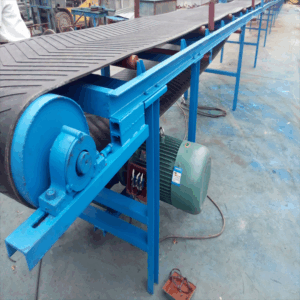
The belt conveyor head pulley is the powered drum at the discharge end of a conveyor. It grips the conveyor belt, turns under load, and throws material off the belt into the next stage, whether that is a crusher, a screen, or a stockpile. Because it transmits the drive torque, this drum is also called the drive pulley or, in many plant drawings, the unloading pulley. Those names describe the same position and function. A tail pulley, by contrast, is the return-end drum that tracks and tensions the belt, while a bend pulley only changes the belt direction. They are not interchangeable with the head drum, and a buyer should keep the position clear when ordering.
Typical duty includes limestone quarries, sand and gravel lines, cement clinker transport, and coal handling at power plants. In these settings the head pulley often runs in dust, moisture, and continuous load, so the shell, shaft, and lagging need to suit the material and the belt speed.
Construction and Key Parts
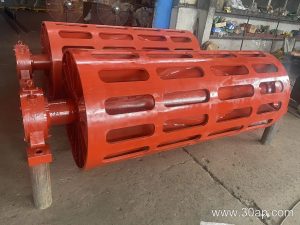
A standard head drum is built around a cylindrical shell, two end discs, a through shaft, and bearing housings. The shell may be seamless pipe or rolled plate. The shaft is sized by torque and bending load, not by belt width alone. Common shaft diameters include Ø50, Ø60, Ø70, Ø80, Ø90, Ø100, Ø120, Ø140, Ø160, Ø180, and Ø200, but the final value follows the design calculation.
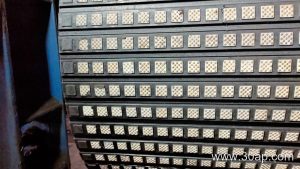
The surface can be plain, or covered with rubber lagging to improve grip. Lagging styles include cold-bonded rubber, hot vulcanized rubber, diamond grooving, herringbone grooving, ceramic tiles, and plain sheet. Common lagging thicknesses are 8, 10, 12, 15, and 20 mm. The right choice depends on wet or dry conditions, belt tension, and the risk of slip.
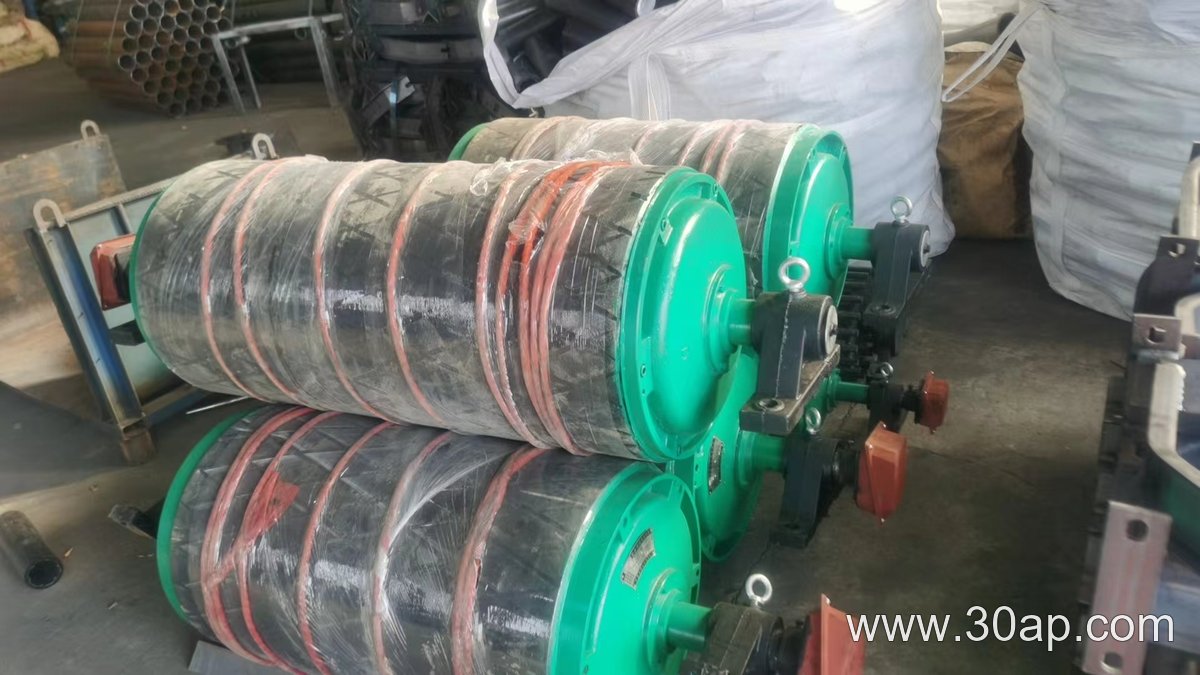
Matching Pulley Diameter to Belt Width
There is no single rule that fixes one diameter for one belt width. A B800 conveyor may use a Ø500 head pulley in a short line and a Ø630 or larger drum where belt tension and layer count demand it. A B1200 line might run a Ø1000 drum, while a B1400 system could use Ø800 or Ø1000 depending on the drive arrangement. The pulley face width is usually a little wider than the belt, for example B650 with a face around 750 mm, or B1000 with a face around 1150 mm.
Use the table below as a starting reference, then confirm against the actual conveyor design.
- B400 belt: face width often about 500 mm, diameter commonly Ø200 to Ø400
- B500 belt: face width often about 600 mm, diameter commonly Ø250 to Ø500
- B650 belt: face width often about 750 mm, diameter commonly Ø315 to Ø630
- B800 belt: face width often about 950 mm, diameter commonly Ø400 to Ø800
- B1000 belt: face width often about 1150 mm, diameter commonly Ø500 to Ø1000
- B1200 belt: face width often about 1400 mm, diameter commonly Ø630 to Ø1250
- B1400 belt: face width often about 1600 mm, diameter commonly Ø800 to Ø1400
- B1600 belt: face width often about 1800 mm, diameter commonly Ø1000 to Ø1600
- B1800 belt: face width often about 2000 mm, diameter commonly Ø1250 to Ø1800
These are common ranges, not fixed pairings. The final diameter also depends on belt speed, wrap angle, and the number of plies.
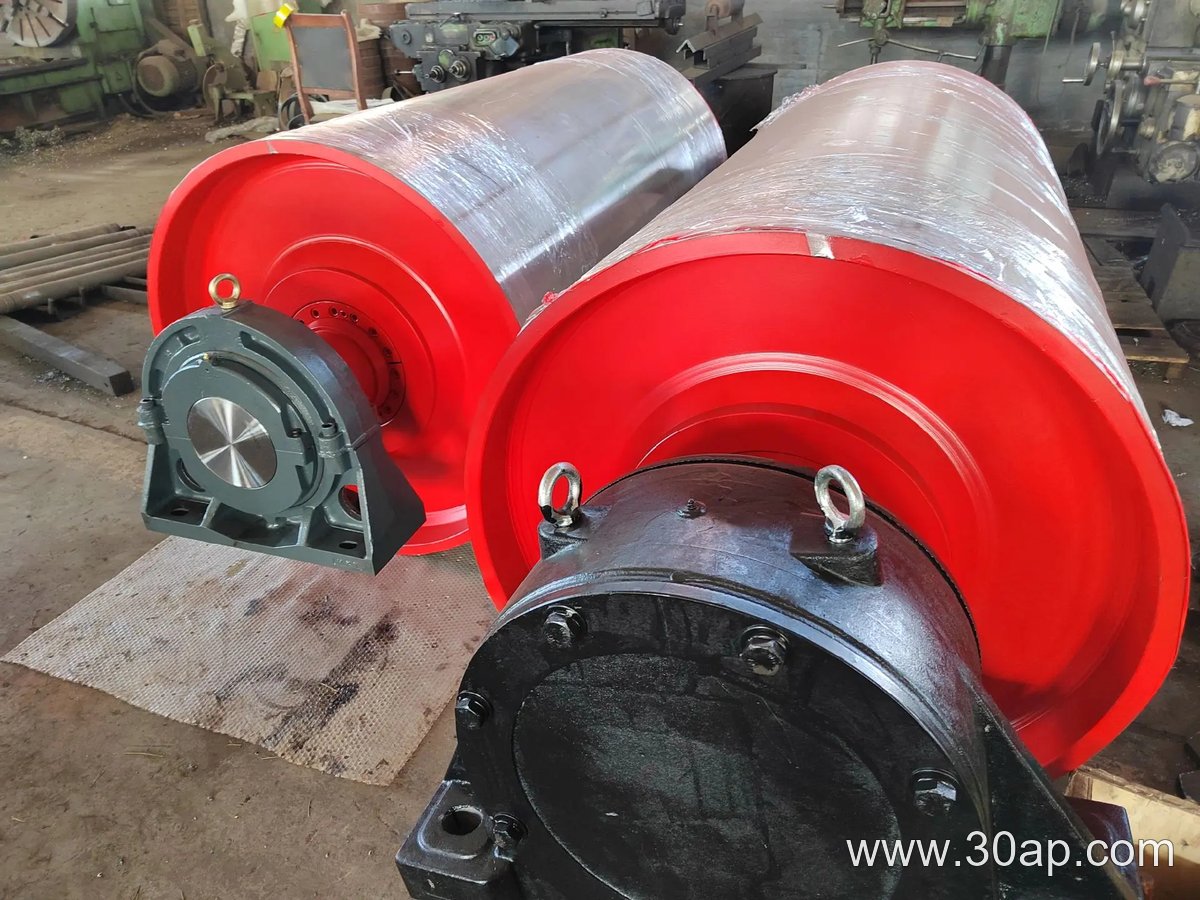
Surface Form and Grip
Lagging is where many head pulley problems are solved or created. Plain steel offers no extra friction and is rarely used on a drive drum in dusty service. Rubber lagging raises the friction coefficient and reduces belt slip. Diamond or herringbone patterns help shed water and fines. Ceramic lagging is chosen where abrasive material and high tension are present. If the conveyor runs in a wet washing plant or a tunnel with seepage, grooved lagging is often more useful than a smooth surface.
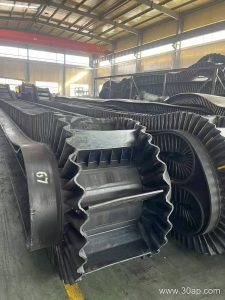
The belt itself matters too. A heavy EP or steel cord conveyor belt needs a drum that can handle the tension without shell deflection. In such cases the head pulley is usually larger and the shaft heavier than a light fabric belt would require.
What a Buyer Should Check
Before ordering a belt conveyor head pulley, confirm the belt width and the required face width, the belt speed, the drive power, and the wrap angle. Ask for the shaft diameter calculation basis, not just a number. Check the lagging type and thickness against the working environment. Confirm the bearing type, housing style, and whether the drum needs a keyed shaft or a locking assembly.
Also check the interface with the conveyor bracket and the supporting structure. A head pulley that fits the frame but not the take-up or the drive coupling will still cause downtime. For a complete conveyor, the head drum, idler roller, and conveyor pulley all work together, but only the head drum carries the main drive duty.