What an NN100 Conveyor Belt Is
An NN100 conveyor belt is a rubber conveyor belt built on a nylon-nylon fabric carcass. The two letters refer to the warp and weft yarns, both of which are nylon, and the number indicates the nominal tensile strength of the carcass in newtons per millimeter of belt width. In everyday plant language it may be called an NN100 nylon conveyor belt or a nylon-nylon belt, and those names describe the same product rather than a different subtype.
Nylon fabric is chosen for its high strength-to-weight ratio, good fatigue resistance, and the ability to absorb impact without cracking. That combination makes this belt a practical option when a conveyor has to survive repeated loading shocks, moderate abrasion, and pulleys that are not perfectly aligned.
How the Belt Is Constructed
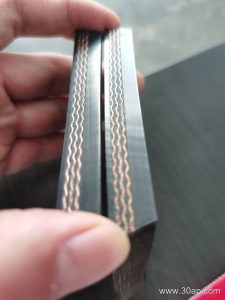
The carcass is the load-bearing part. In an NN100 belt it usually consists of two to six plies of nylon fabric bonded together with rubber skim compound. The number of plies and the exact fabric weight are selected by the belt designer according to the duty, the belt width, and the required safety factor, so two suppliers may not build the same NN100 construction for the same conveyor.
On top of the carcass sits the cover rubber, which protects the fabric from wear, moisture, and the material being carried. Common cover thickness combinations include 3+1.5 mm, 4+2 mm, 5+2 mm, 6+2 mm, and 8+3 mm, where the first figure is the top cover and the second is the bottom cover. These are reference values rather than a fixed menu; the right choice depends on lump size, abrasion, and whether the belt runs over a tripper or a plough.
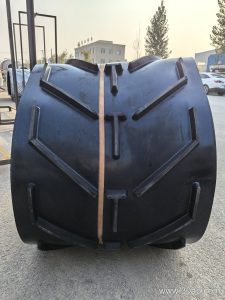
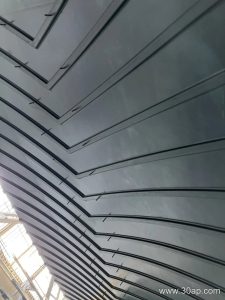
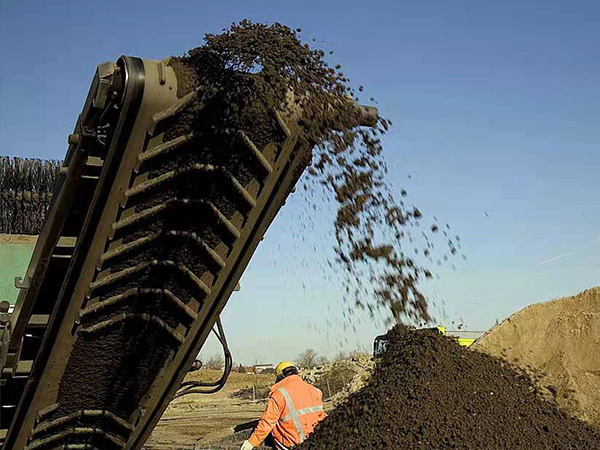
Special cover grades are available for different service conditions. A heat-resistant grade suits hot clinker or sinter, an oil-resistant grade suits greasy or oily loads, and a flame-retardant or antistatic grade is used where fire risk or static discharge must be controlled. For inclined conveyors, a patterned or chevron surface can be specified instead of a smooth cover, and corrugated sidewalls can be added when the belt must contain material on a steep slope. These are variations of the same NN100 carcass product family, not replacements for it.
Where NN100 Belts Are Used
This belt is common in medium-duty conveying: crushed stone, sand and gravel, coal, fertilizer, grain, wood chips, and general bulk goods. It also appears in package handling and light assembly lines where the belt width is modest and the load is steady.
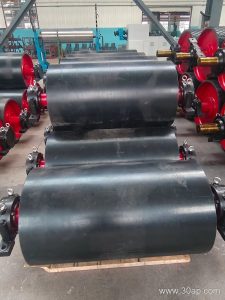
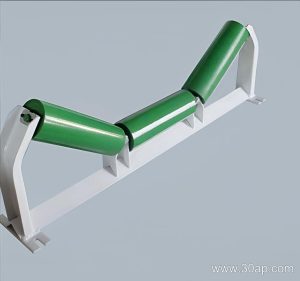
It is often found on conveyors running at moderate speed over troughing idler rollers and returning over flat return rollers. At the head end the belt passes over the drive pulley, at the tail end over the tail pulley, and at any change of direction over a bend pulley. Each of these pulleys has a different job, and they are not interchangeable names for the same component. The belt also runs through a conveyor bracket or frame that holds the idlers and pulleys in alignment.
When the conveyor is short and the material is light, an NN100 belt may be more than enough. Where the duty is very heavy, a steel cord belt or a higher-strength EP belt may be considered instead. That comparison is about matching the carcass to the load, not about one product being universally better.
Choosing the Right Construction
Buyers should start with the actual duty rather than a catalogue number. The key questions are the belt width, the center distance, the lift or drop, the capacity in tonnes per hour, the maximum lump size, and the material temperature. From those figures a belt supplier can calculate the required tensile strength and confirm whether NN100 is suitable.
Belt width and pulley diameter are separate decisions. A wider belt does not automatically mean a larger pulley, and a given belt width does not dictate one fixed shaft diameter. Pulley dimensions follow the belt tension, the bearing load, and the shaft stress calculation. Do not assume that a B800 belt must fit a particular pulley size, or that a B1000 belt requires a specific shaft diameter; those values come from the conveyor design.
It also helps to check the smallest pulley the belt will run over. A thick, multi-ply NN100 belt needs a larger minimum pulley diameter than a thin two-ply belt, because bending stress accumulates as the belt wraps around a small roll. If the existing conveyor has small pulleys and tight transitions, a lighter construction may last longer than a heavier one.
Installation and Maintenance Notes
Store NN100 belts away from direct sunlight, ozone sources, and standing water. When installing, pull the belt straight, keep the splice square, and check that the idler rollers and conveyor pulley faces are clean and aligned. Misalignment is a common cause of edge wear and premature cover failure.
During operation, watch for material spillage at the loading point, because trapped lumps can damage the cover and the carcass. Check the belt tracking, the condition of the pulley lagging, and the freedom of the return rollers. A belt that runs off-center will rub the frame and wear quickly, no matter how good the rubber compound is.
Finally, keep a record of the belt specification: carcass type, number of plies, cover thickness, and cover grade. When a replacement is needed, that record lets a supplier match the original duty instead of guessing from the belt width alone.