Why Ceramic Lagging Changes the Grip Equation
A ceramic pulley is a conveyor pulley whose shell is covered with ceramic tiles set into a rubber or polymer backing. The tiles give the pulley face a hard, gritty texture that bites into the belt cover, which is why this style of lagging is often chosen where a plain rubber surface would polish smooth or wear unevenly. In a quarry, a cement plant, or a coal handling line, the head pulley has to transmit drive torque without slipping, and the ceramic face is one way to hold that grip over a long service interval.
The ceramic pulley and its close equivalent, the ceramic lagged drum pulley, are the same product described two ways. Both refer to a pulley shell finished with ceramic lagging rather than plain steel or smooth rubber. The distinction matters when a buyer is comparing quotations, because a supplier may use either term for the same item.
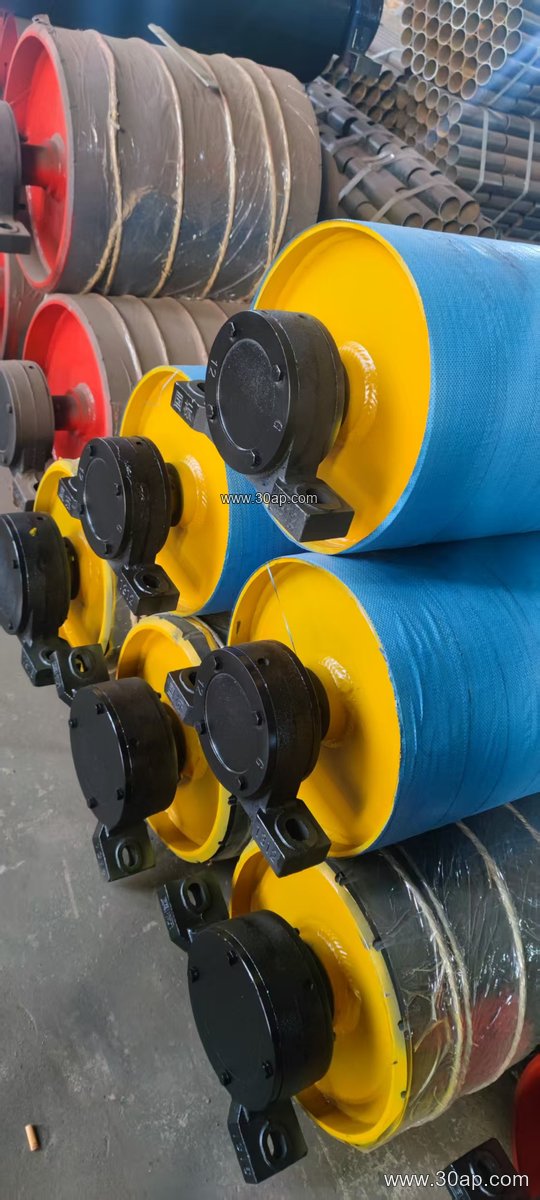
How the Ceramic Surface Is Built
The usual construction starts with a steel shell, welded to end discs and a shaft hub. Lagging is then applied in one of two common ways: tiles bonded to a rubber sheet that is wrapped and vulcanized onto the shell, or tiles set directly into a cast or bonded polymer layer. Tile shapes vary, and many designs leave small raised studs or a dimpled pattern so that water, fines, and slurry can escape from under the belt instead of being trapped.
- Shell: rolled steel plate, machined at the ends for concentricity
- Lagging: ceramic tiles in a rubber or polymer matrix, commonly 8 to 20 mm thick
- Surface forms: flat tile layout, studded or ribbed patterns for wet duties
- Hubs and shaft: keyed or shrink-fit connection, sized by torque and load
Bonding quality is the point most worth checking. A tile that lifts at the edge will start a chain of failures, so a buyer should ask how the lagging is attached and whether the tile pattern is continuous across the full face width.
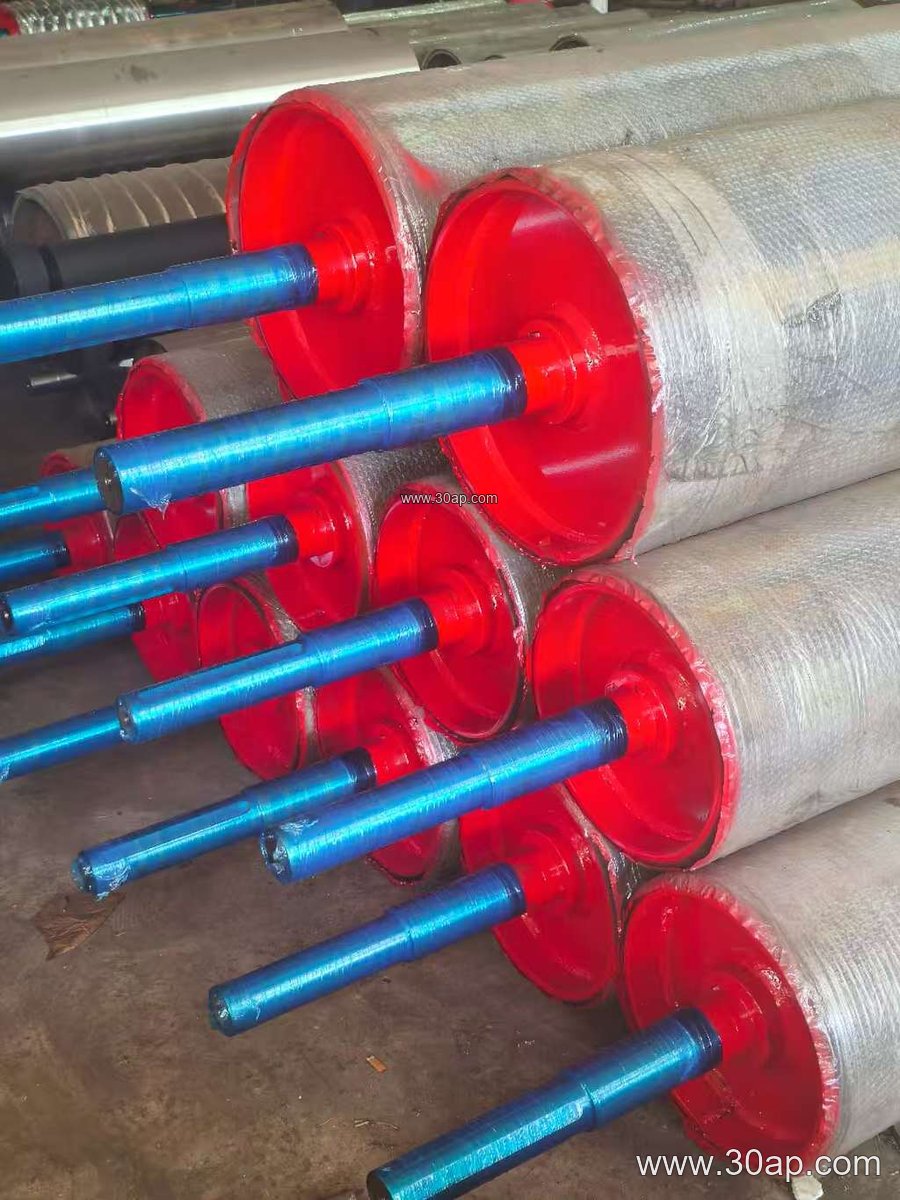
Where It Fits in the Conveyor Layout
The ceramic pulley is most often specified as a drive pulley at the discharge end, where wrap angle and belt tension are highest. It also appears as a tail pulley or a bend pulley in wet, gritty service, though each position has its own demands. A drive pulley must resist torque and slip; a tail pulley mainly guides the belt and tolerates fines; a bend pulley changes direction with a modest wrap. These roles are not interchangeable, and a ceramic face chosen for a drive position should not be assumed to suit a snub or take-up position without checking the load.
In a limestone mine or a sand and aggregate line, the belt often carries damp material that coats the pulley face. Ceramic lagging sheds that coating better than smooth rubber, which keeps friction more stable. In a power plant coal handling system, the same property helps where dust combines with moisture. Where the belt itself is a heavy-duty mining conveyor belt or an abrasion resistant conveyor belt with a thick cover, the ceramic studs press into the cover without cutting it, provided the tile height and belt cover hardness are matched.
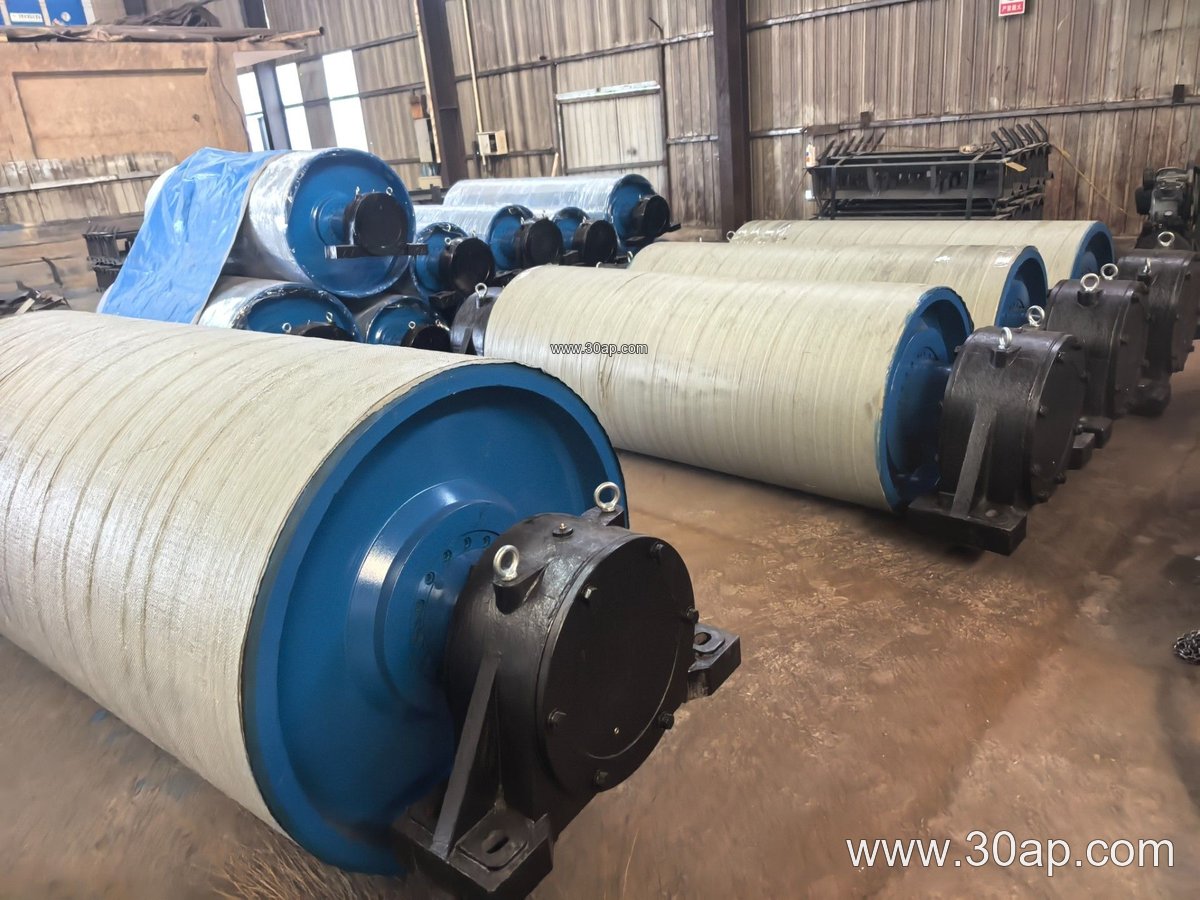
Matching Pulley, Belt, and Duty
Selection usually begins with belt width and working tension, then moves to diameter and lagging. Face width is normally a little wider than the belt, for example about 950 mm for a B800 belt or about 1400 mm for a B1200 belt, but these are reference proportions rather than fixed rules. Common combinations such as B800 × Ø500 or B1200 × Ø1000 appear in layouts, yet a given belt width can be paired with more than one diameter depending on wrap angle and tension.
| Parameter | Common range | Notes |
|---|---|---|
| Belt width | B400 to B2400 | Face width generally exceeds belt width |
| Pulley diameter | Ø200 to Ø1800 | Set by belt tension and wrap angle |
| Lagging thickness | 8, 10, 12, 15, 20 mm | Thicker lagging for high wear |
| Shaft diameter | Ø50 to Ø200 | Determined by torque and bearing load |
A shaft diameter cannot be read off the belt width alone; it follows from the drive torque, the bearing span, and the allowable deflection. Buyers should provide the belt tension, the pulley position, and the material being handled so the supplier can size the shaft properly.
Buyer Checklist Before Ordering
- Confirm the pulley role: drive, tail, bend, or take-up, since each has different loads
- State the conveyor belt type and cover hardness, especially for a steel cord conveyor belt or a heat resistant conveyor belt
- Ask for the tile bonding method and the lagging thickness in millimetres
- Provide belt width, pulley diameter, and shaft diameter as a set, not as isolated figures
- Check that the face width and the conveyor bracket spacing match the existing frame
- Confirm the surface pattern suits wet or dry conditions at the installation site
Ceramic lagging is not the answer for every position. A plain rubber or diamond-grooved lagging may be adequate on a lightly loaded bend pulley, and a smooth face is easier to clean in some food or fine-material duties. The value of the ceramic pulley lies in sustained friction under abrasive, damp, or dusty conditions, which is why it turns up in ore handling, clinker lines, and coal conveying where slip would otherwise shorten belt life. Matching the lagging to the actual duty, rather than to a catalogue default, is what keeps the pulley and the belt working together.