What a Large Pulley Is and Where It Fits
A large pulley is a high-capacity conveyor pulley engineered for wide belts and heavy loads. In a bulk material handling line, it serves as the main drive or tail pulley, transferring motion to the conveyor belt and maintaining tension. You will find these pulleys in coal mining, cement plants, iron ore terminals, power plant coal yards, and large quarry operations where reliability under constant stress is essential. Unlike an idler roller that supports the belt along its run, a large pulley carries the full belt tension and torque at key transition points.
The term often refers to a conveyor pulley with a diameter typically from Ø800 mm up to Ø1800 mm and face widths that accommodate belts from B1000 to B2400. For example, a B1400 belt may run on a pulley with a Ø1000 mm shell and a 1600 mm face width. These dimensions are common references, not fixed rules; final sizing depends on belt tension, shaft load, and the specific conveyor profile.
Construction and Surface Options
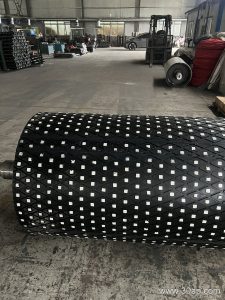
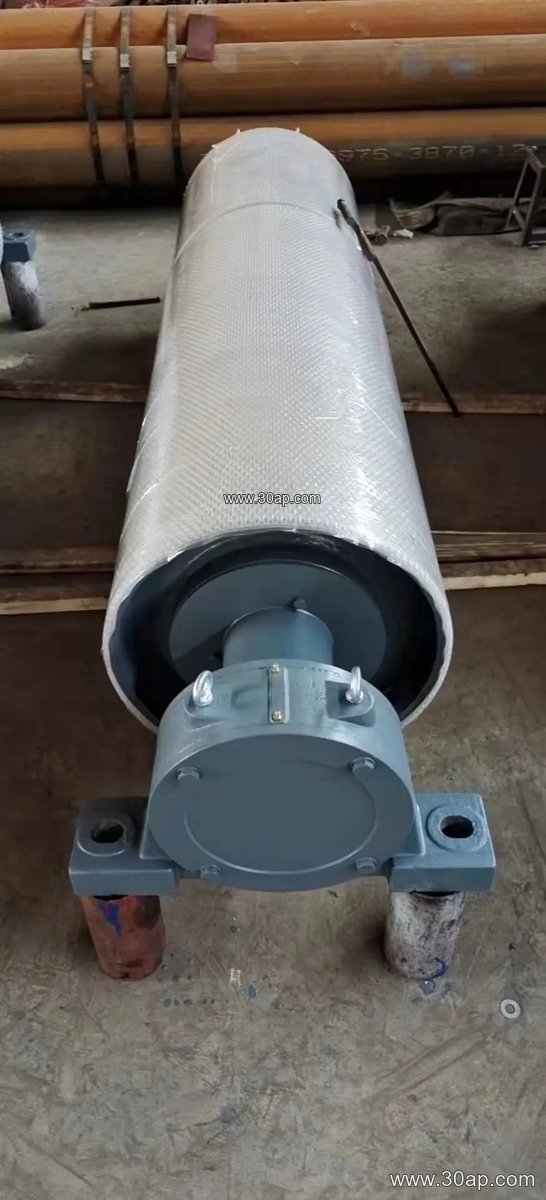
A large pulley is built around a robust steel shell, welded to end discs and a central hub. The shaft is sized by torque and radial load—common shaft diameters range from Ø120 mm to Ø200 mm for these units. The shell surface can be plain, or covered with rubber lagging applied by cold bonding or hot vulcanization. Lagging thicknesses of 8, 10, 12, 15, or 20 mm are available, and the pattern may be diamond, herringbone, or ceramic for extra grip.
For dusty or wet conditions, diamond lagging helps shed material and maintain friction. In coal mining, flame retardant and anti-static properties are often required for the belt, and the pulley lagging should be compatible with that environment. A large pulley on a heavy-duty mining conveyor belt may also feature a ceramic lagging for high abrasion resistance where the belt carries sharp rock.
Matching the Pulley to the Belt and the Job
Selecting a large pulley starts with the belt width and the required diameter. The pulley face width is usually greater than the belt width—for instance, a B1200 belt would pair with a face width around 1400 mm. The diameter must be large enough to limit belt bending stress and to provide adequate contact area for torque transmission. A B800 belt might use a Ø500 mm pulley in a lighter duty application, while a B1800 belt on a main drive could require Ø1250 mm or more.
The type of conveyor belt also matters. A steel cord conveyor belt, such as ST1600 or ST2000, demands a pulley with sufficient diameter to avoid fatigue in the cord layer. Fabric core belts like EP200 or NN300 are more forgiving, but still need proper diameter to prevent ply separation. When the belt is a pipe conveyor belt or a corrugated sidewall belt, the pulley design must account for the belt profile and any cleats or sidewalls.
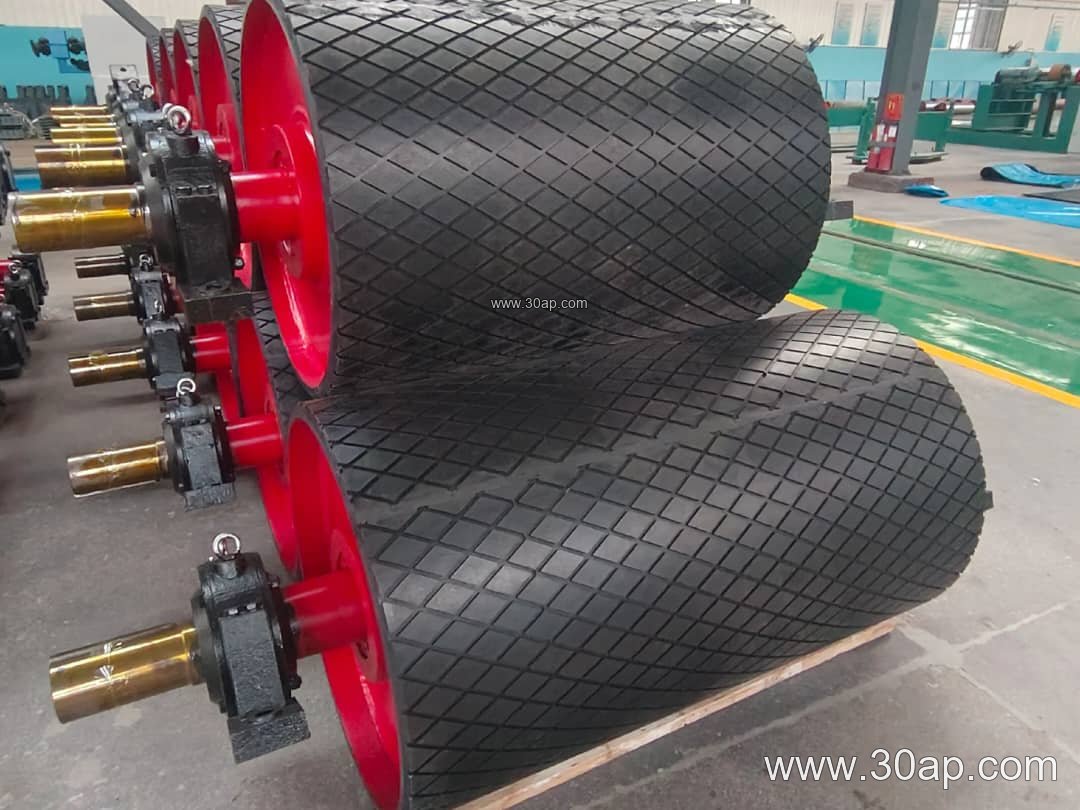
Drive, tail, and bend pulleys are not interchangeable. A drive pulley transmits power and often has a lagged surface; a tail pulley redirects the belt and may be smaller; a bend pulley changes direction without driving. Each position imposes different loads, so the pulley specification must match its role.
Key Parameters for Buyers
When specifying a large pulley, consider the following typical parameter ranges. These are for reference only and should be confirmed by engineering calculation.
| Parameter | Common Range |
|---|---|
| Belt width (B) | B1000 to B2400 |
| Pulley diameter | Ø800 to Ø1800 mm |
| Face width | Usually belt width + 100 to 200 mm |
| Shaft diameter | Ø120 to Ø200 mm (by torque) |
| Lagging thickness | 8, 10, 12, 15, 20 mm |
| Lagging pattern | Plain, diamond, herringbone, ceramic |
Bearing selection, hub design, and locking assemblies are equally important. A large pulley for a copper ore conveyor might need a heavy-duty bearing housing to handle shock loads, while a pulley in a cement plant clinker line may require heat-resistant lagging if radiant heat is present.
Installation and Maintenance Notes
Proper alignment is critical. A misaligned large pulley will cause belt tracking problems and accelerated wear on both the pulley lagging and the conveyor belt. Check the pulley squareness to the conveyor centerline during installation. Regularly inspect lagging for wear, glazing, or missing segments—especially on drive pulleys where slip can occur. Keep the pulley surface clean; material buildup can change the effective diameter and cause vibration.
Lubricate bearings according to the manufacturer’s schedule, and monitor for abnormal noise or temperature rise. When replacing a large pulley, verify the shaft diameter and keyway dimensions match the new unit, and confirm that the belt tensioning system can accommodate the pulley change. For a quarry conveyor belt or an aggregate conveyor belt, dust ingress is a common cause of bearing failure, so seals should be checked periodically.
Where Large Pulleys Prove Their Value
In a coal mining operation, a large pulley on the main trunk conveyor must handle continuous tonnage and often hazardous conditions. Flame retardant conveyor belt and anti-static properties are typical, and the pulley lagging must resist coal dust and moisture. In a cement plant, large pulleys move clinker and raw meal over long distances; heat resistant conveyor belt may be used near kilns, and the pulley surface should tolerate elevated temperatures without losing grip.
At a port bulk terminal, a large pulley on a ship loading conveyor belt system needs high reliability to avoid costly downtime. The pulley diameter may be Ø1600 mm or more to handle the belt width and tension. In an iron ore terminal, abrasion resistant conveyor belt paired with ceramic-lagged pulleys reduces wear and extends service life.
Whether the application is a primary crusher discharge or a transfer point in a sand making plant, the large pulley remains a critical component. By understanding its construction, matching it correctly to the belt and duty, and maintaining it properly, operators can achieve reliable conveying with minimal interruption.