What a Diamond Grooved Lagged Pulley Does
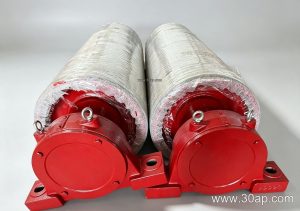
A diamond grooved lagged pulley is a conveyor pulley whose shell is covered with rubber lagging carrying a raised diamond pattern. The diamond profile is what separates it from a plain lagged or smooth-faced pulley: the crisscross grooves give trapped water and fine dust somewhere to escape, while the raised diamonds press into the underside of the belt. The result is a drive or tail pulley that holds traction on damp, dusty or slightly contaminated running surfaces where a flat rubber cover might slip.
In a conveyor line, this component is one of several conveyor pulley positions, and it should not be confused with a bend pulley. A bend pulley only changes belt direction; the diamond grooved lagged pulley is normally selected where torque has to be transmitted to the belt, or where tracking at the tail end matters.
How the Pulley Is Built
The core is usually a welded steel drum with end discs and a through shaft, machined so the lagging sits evenly. Rubber lagging is then bonded to the shell, either by hot vulcanisation in a press or by cold bonding. The diamond pattern is formed during vulcanisation or cut afterwards, and the groove depth and diamond pitch are chosen to suit the belt and the duty.
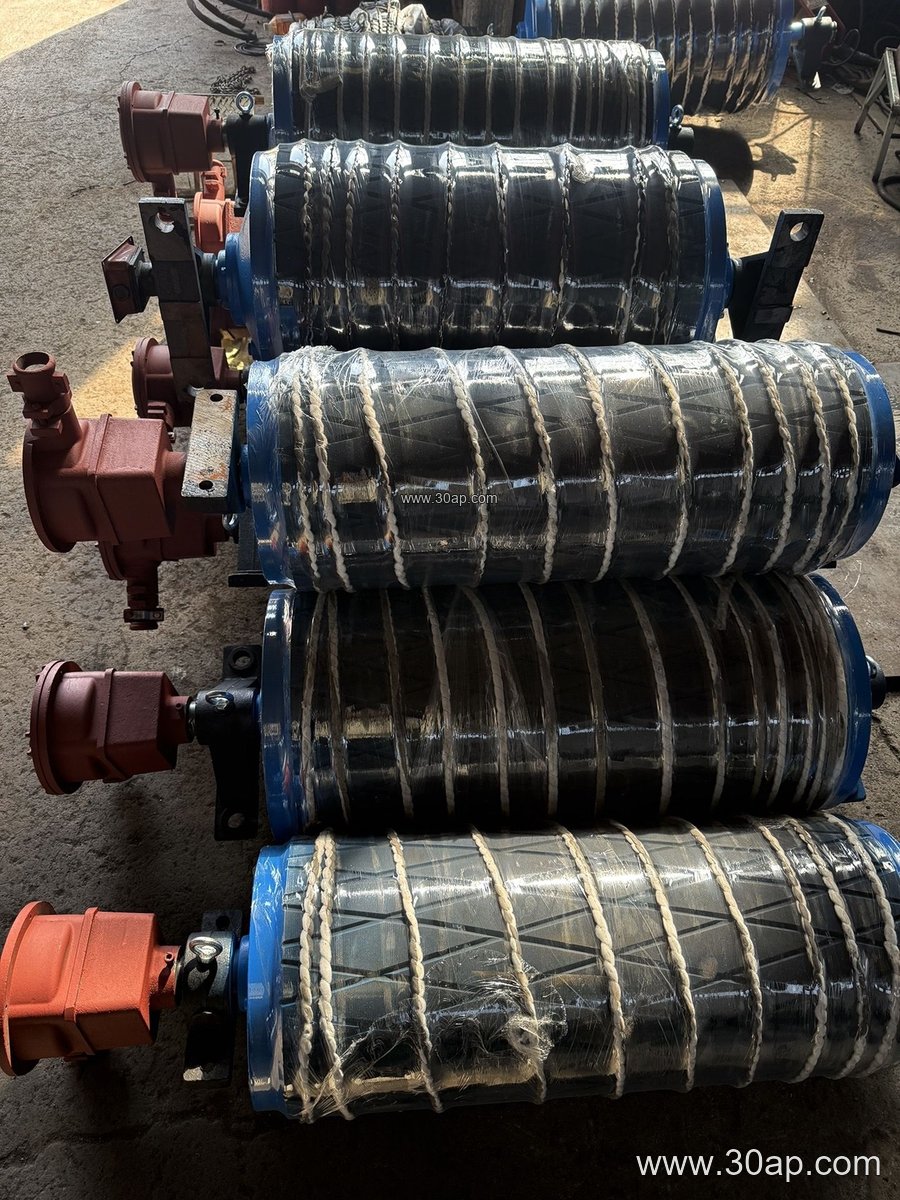
- Shell and shaft: shaft diameter is sized from torque and radial load, not from belt width alone. Typical shaft sizes run from about Ø50 to Ø200 mm, with larger shafts on high-tension drives.
- Lagging thickness: common values are 8, 10, 12, 15 and 20 mm; thicker covers suit heavier contact pressure and longer wear life.
- Face width: the drum face is normally wider than the belt, for example about 950 mm for a B800 belt and about 1400 mm for B1200.
- Diameter: common pulley diameters include Ø200, Ø315, Ø400, Ø500, Ø630, Ø800, Ø1000 and Ø1250 mm, matched to belt tension and wrap angle.
Where It Fits in a Conveyor
The most common duty is as a head or drive pulley on a medium-length conveyor. In a quarry or aggregate line feeding a crusher, the drive pulley often works in a wet, gritty environment, and the diamond grooves help the lagging shed water instead of hydroplaning under the belt. In a coal handling plant or a power station coal yard, the same cover is used where fine coal dust settles on the shell.
At the tail end, a diamond grooved lagged pulley can also serve as the tail pulley, helping keep the belt centred when the return strand carries sticky material. On some installations it appears as a take-up or tension pulley, but in that position a plain or grooved cover may be sufficient, since the main requirement is guiding rather than grip.
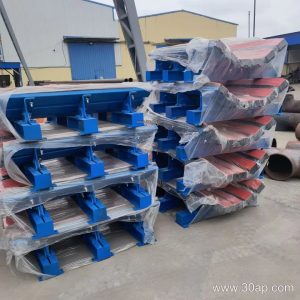
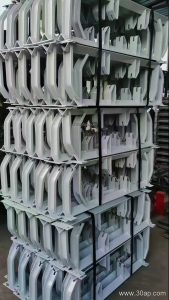
Whatever the position, the pulley works together with the rest of the line: the conveyor belt, the idler roller sets on the carrying and return sides, and the conveyor bracket that anchors the pulley bearing housings. A poorly aligned bracket will wear the lagging unevenly no matter how good the diamond pattern is.
Matching the Pulley to the Belt
Selection starts with the belt, because the pulley surface has to suit the belt cover and the material being carried. A heavy abrasive duty such as iron ore or copper ore may call for an abrasion resistant conveyor belt, and the pulley lagging should be equally tough. A coal mining conveyor belt with flame retardant properties is often paired with fire resistant lagging in underground or enclosed galleries.
On long overland or high-tension conveyors, a steel cord conveyor belt or a high strength EP conveyor belt such as EP1000 or EP1250 may need a larger diameter and a thicker lagging to keep contact pressure within limits. Fabric core belts, including multi-ply fabric core conveyor belt constructions, generally work well with standard diamond lagging.
Belt widths are not tied to one pulley diameter. A B800 belt might run on a Ø500 mm pulley in a short transfer, or on a Ø800 mm pulley where tension and wrap angle demand it. Likewise, B1200 × Ø1000 and B1400 × Ø800 are both realistic combinations depending on the drive design. Buyers should supply belt width, belt type, motor power, belt speed and the expected material, and let the pulley be calculated rather than copied from a table.
Buyer Checklist
- Confirm the pulley position: drive, tail, take-up or snub, since each has different traction needs.
- Specify lagging thickness and diamond pattern, and state whether hot vulcanised or cold bonded rubber is preferred.
- Give the belt construction and cover grade, including whether a heat resistant conveyor belt or oil resistant conveyor belt is involved.
- Check shaft diameter against calculated torque, not against belt width.
- Ask how the lagging is bonded and how the diamond grooves are formed, as this affects service life.
For more on conveyor pulleys and matching components, see www.example.com/conveyor-pulley and www.example.com/diamond-grooved-lagged-pulley.