What a Conveyor Support Leg Actually Does
A conveyor support leg is the vertical member that carries the weight of the conveyor frame, the idler roller sets, the conveyor belt and the material being moved, then transfers that load safely into the floor, foundation or steel structure below. In many plants the leg is treated as a minor part, yet it sets the height of the belt line, keeps the frame level, and absorbs vibration coming from the drive and from lumpy loads. On a quarry conveyor belt or a coal mining conveyor belt, a poorly anchored leg can cause misalignment that shows up as edge wear and spillage far from the leg itself.
Also called a conveyor stand leg or frame leg, this component is normally matched to the frame it supports rather than bought on its own. The same article covers both names.
How the Leg Is Built
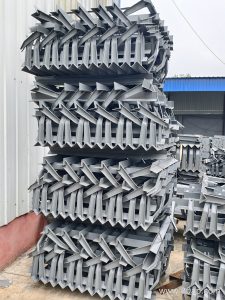
Most legs are fabricated from angle steel, channel steel or folded steel plate. A simple leg may be a single folded section with a base plate welded at the bottom and a bolted connection at the top. Taller frames often use a pair of legs braced together with a cross member to resist sideways movement.
Key construction details a buyer should check include:
- Base plate thickness and hole pattern for anchor bolts
- Top connection, which may be bolted to a conveyor bracket or welded to the frame
- Height adjustment slots or shim plates for final levelling
- Surface treatment, such as painting or galvanising, for dusty or humid sites
Where the leg meets an idler roller support, the connection should allow the bracket to sit square to the belt centreline. A slight twist here is enough to make a troughing set run out of line.
Where These Legs Are Used
Support legs appear wherever a conveyor is raised above ground level. In a limestone mine or crushing and screening line, legs hold the transfer conveyors that carry rock from the crusher to the stockpile. In a power plant coal yard, they support the long overland runs feeding the boiler bunkers. In a cement plant they are used under clinker and raw meal conveyors, and in a fertilizer or grain silo facility they keep the belt line clear of the floor for cleaning.
Two site conditions usually drive the design. The first is load: a heavy-duty mining conveyor belt carrying iron ore needs a stiffer leg than a light aggregate conveyor belt. The second is environment: wet washing plants, coastal ports and underground mining conveyor belts call for better corrosion protection and, in coal mines, flame retardant conveyor belt systems are paired with legs that resist dust build-up.
Matching the Leg to Belt Width, Trough Angle and Roller Diameter
The leg is part of a system, so its dimensions follow the frame design rather than standing alone. Common belt widths include B500, B650, B800, B1000, B1200, B1400, B1600, B1800, B2000, B2200. Trough angles of 20, 30, 35 and 45 degrees are typical, and roller diameters such as Ø89, Ø108, Ø133, Ø159 and Ø194 are common. These values are reference data; the actual combination is set by the conveyor designer.
The table below shows how the same leg family can serve different frame arrangements. It is an example of typical practice, not a fixed rule.
| Frame arrangement | Belt width | Trough angle | Roller diameter | Leg note |
|---|---|---|---|---|
| Light aggregate line | B650 | 30 degrees | Ø89 | Single folded leg, bolted base |
| General quarry duty | B800 | 35 degrees | Ø108 | Channel leg with cross brace |
| Heavy transfer point | B1200 | 45 degrees | Ø133 | Reinforced leg under impact zone |
| Long overland run | B1400 | 35 degrees | Ø159 | Tall leg, adjustable height |
| High capacity main line | B1800 | 45 degrees | Ø194 | Paired legs with bracing |
One belt width does not lock in a single trough angle or roller diameter, and installation hole spacing and cross beam length change with both belt width and trough angle. Treat any figure as a starting point for discussion with the fabricator.
Fixed, Adjustable and Special Legs
A fixed support leg is welded or bolted at a set height. It is simple and rigid, and works well where the floor is level and the belt line is final. An adjustable support leg uses slotted holes, threaded rods or shim packs so the frame can be levelled after installation and re-set if the foundation settles. Adjustable types are useful in tunnels, on portable plants and in plants where the conveyor may later be extended.
Other frame members are sometimes confused with this part. A transition support leg near the drive or tail pulley carries a different load pattern from a standard intermediate leg, while a V-return bracket or a self-aligning bracket is a bracket, not a leg. Drive pulley, tail pulley and bend pulley are separate components entirely and are never substitutes for a leg.
What Buyers Should Ask Before Ordering
Before placing an order, confirm the belt width, trough angle, roller diameter and the height from floor to frame top. Ask how the leg connects at the top, what anchor bolt pattern the base plate uses, and what surface treatment suits the site. For a coal mining conveyor belt installation, check that the leg and its coating will not create a spark or fire risk, and for a heat resistant conveyor belt line, allow for thermal expansion in long frames.
Finally, request the leg drawing together with the frame layout so the conveyor bracket positions line up. A support leg that fits the drawing but not the frame costs more to fix than to specify correctly the first time.