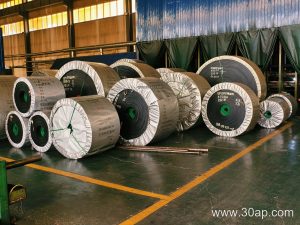
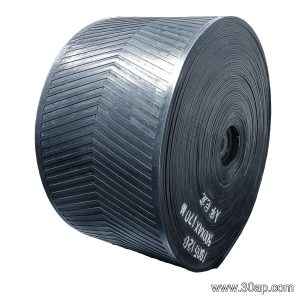
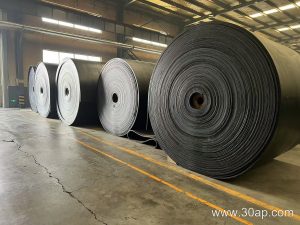
What a PVC Mining Conveyor Belt Is
A PVC Mining Conveyor Belt is a solid-woven or fabric-reinforced belt whose cover compound is based on polyvinyl chloride rather than plain rubber. In many underground coal and soft-rock operations it is chosen for its combination of flame resistance, anti-static behaviour and moderate oil resistance, which are useful where dust, methane and occasional grease exposure are part of daily life. The belt is often supplied as a PVG Conveyor Belt, meaning the carcass is impregnated and covered with PVC, and it is frequently grouped with PVG800 or PVG800S specifications when buyers compare whole-belt properties. It is not the same product as a steel cord or heavy EP rubber belt, although all of them may run on the same structure.
Construction and Lay-Up
The carcass is usually a multi-ply fabric core, with plies of synthetic yarn bonded together and then coated on both faces. Cover thickness is commonly quoted in paired figures such as 3+1.5 mm, 4+2 mm or 5+2 mm, and the number of plies typically ranges from two to six depending on the duty. The PVC compound gives the belt a smooth, low-friction surface that resists moisture and many mild chemicals, and it can be formulated for anti-static and flame-retardant performance. Because the cover is not a pure rubber skin, the belt is generally less suited to hot material than a Heat Resistant Conveyor Belt, and it should not be treated as a substitute where sharp, hot clinker or large run-of-mine rock is the main load.
Where It Fits in the Plant
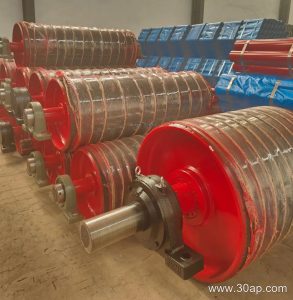
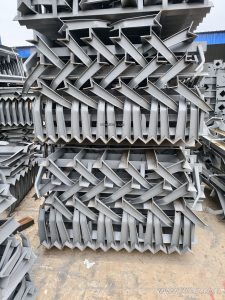
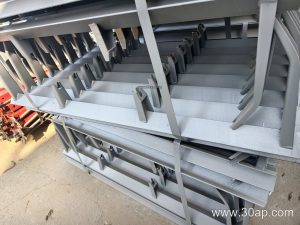
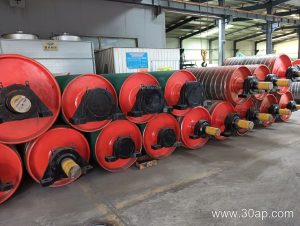
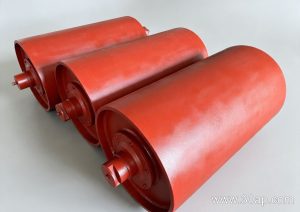
Typical duty is underground coal haulage, drift conveyors, gate roads and surface transfer points in coal preparation plants. It also appears in cement plants, gypsum and salt handling, and some sand and gravel circuits where flame resistance is requested but temperatures stay moderate. In these layouts the belt runs over conveyor idler rollers and is trained by conveyor pulleys at the head, tail and bend positions; each pulley type has its own job and they are not interchangeable. Support frames, conveyor brackets and take-up units are selected around the belt width and the load, not the other way round. A quarry or aggregate yard that handles very abrasive stone may still prefer an Abrasion Resistant Conveyor Belt in rubber, so the choice should follow the material and the environment rather than habit.
Common Widths and Strength References
Widths for this product family are usually ordered in round metric sizes. The table below collects reference values that appear in general catalogue ranges, not a guaranteed stock list.
| Parameter | Common reference values |
|---|---|
| Belt width | B500, B650, B800, B1000, B1200, B1400, B1600, B1800, B2000 |
| Cover thickness | 3+1.5 mm, 4+2 mm, 5+2 mm, 6+2 mm, 8+3 mm |
| Carcass plies | 2 to 6 plies |
| Strength class examples | PVG800, PVG800S, PVG1000, PVG1250 |
These figures are design references. A 1000 mm or 1200 mm belt is not tied to one pulley diameter, and the shaft size follows the pulley and bearing design rather than the belt width alone. Final specification should come from the conveyor designer and the belt maker’s data sheet.
Selection and Care Notes
- Check the flame and anti-static requirement of the mine or plant before ordering; a standard PVC belt may not meet an underground coal specification.
- Match cover thickness and ply count to lump size, drop height and tonnage; impact at a transfer point is a frequent cause of cover damage.
- Keep conveyor idler rollers turning freely and aligned, since a seized roller can wear a groove through the PVC cover quickly.
- Inspect splice quality and edge condition at each shutdown; PVC belts can be spliced with vulcanised or mechanical methods depending on the carcass.
- Where oil or solvent spillage is heavy, confirm chemical compatibility, and consider an Oil Resistant Conveyor Belt if the exposure is continuous.
For wider plant layouts, the same structure may carry a Fabric Core Conveyor Belt in EP or NN construction on the surface sections, while the underground PVC belt handles the flame-sensitive run. That mixed approach keeps each section matched to its duty. Buyers comparing quotations should ask for cover thickness, ply count, strength class and splice method in writing, and should confirm that the offered PVG grade suits the local mining authority’s requirements. At conveyor-belt-accessories.com we cover belt, idler roller and pulley selection for coal, cement, power and quarry plants, so the belt and its supporting components can be reviewed together.