What a Self-Aligning Idler Set Does
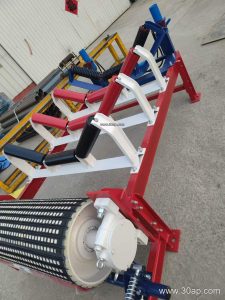
A self-aligning idler set is a group of idler rollers mounted on a pivoting frame that corrects belt misalignment as it happens. Instead of being fixed square to the conveyor structure, the frame swings slightly around a central pivot, and the rollers steer the conveyor belt back toward the center line. On a long bulk material conveyor, a few of these sets placed at strategic points can prevent edge damage, spillage, and the extra friction that comes from a belt rubbing against the structure.
The same product is also described in the field as a self-aligning roller set or self-tracking idler group. Whatever the name, the working principle is the same: a skewed roller produces a small sideways force on the belt, and the pivot lets that force act in the direction that restores tracking.
How the Assembly Is Built
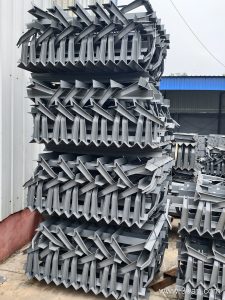
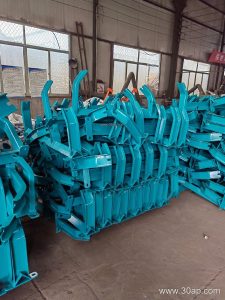
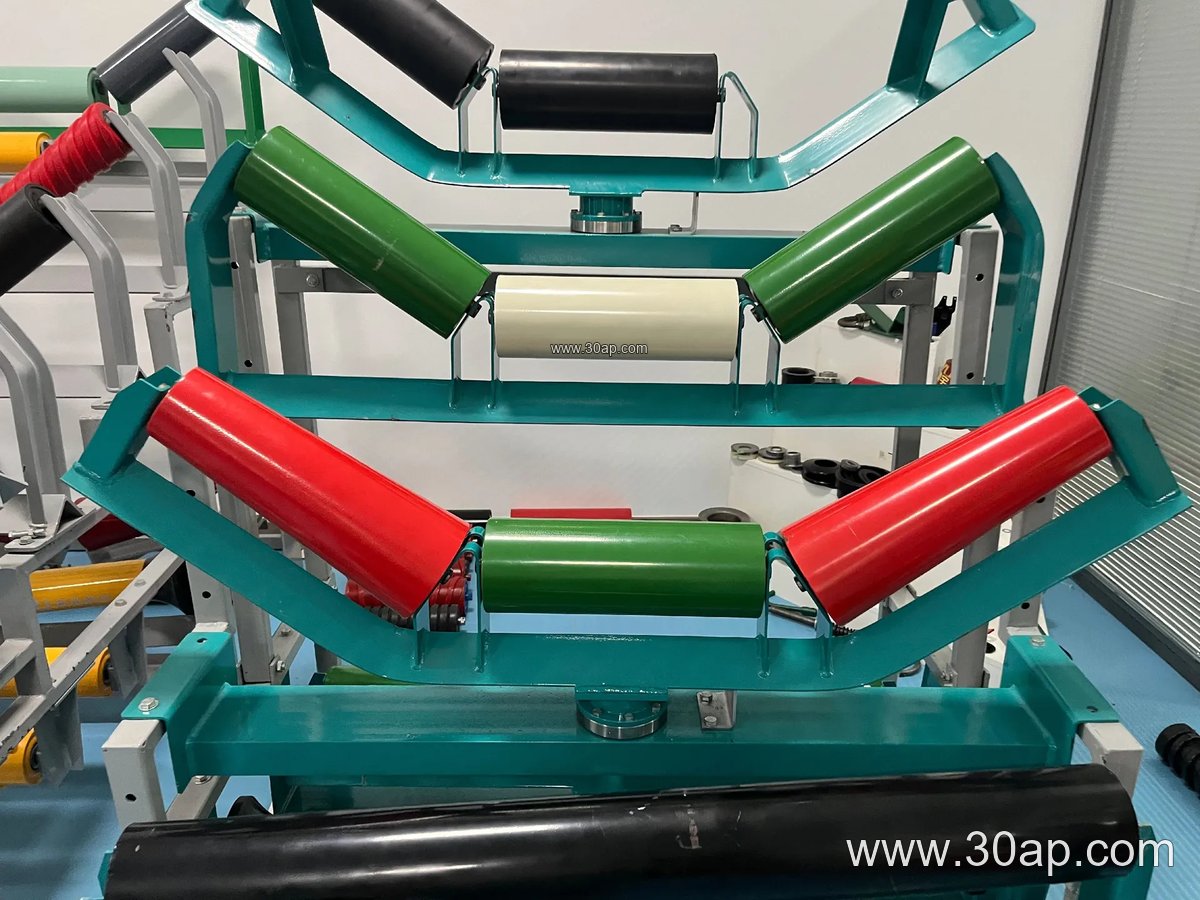
A typical set combines a rigid base, a rotating frame, and two to three idler rollers. The rollers usually follow the trough angle of the carrying run, so a three-roll set may use a 20, 30, 35, or 45 degree trough. Return-side versions often use two rollers in a V form or a flat arrangement. Common roller diameters include Ø89, Ø102, Ø108, Ø127, Ø133, Ø159, and larger sizes for heavy-duty mining conveyors, while roller length follows belt width, trough angle, and the number of rolls in the set.
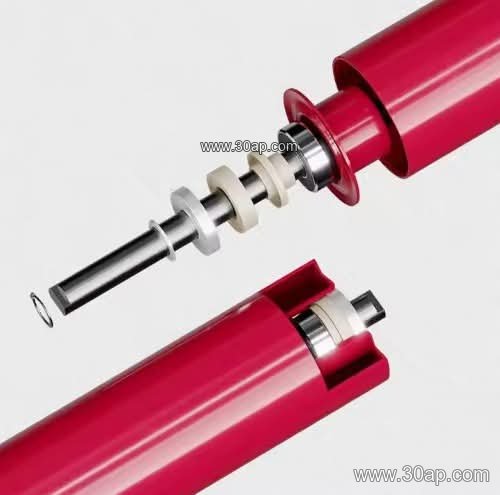
- Pivot bearing or swivel base that allows limited rotation
- Frame with mounting holes matched to the conveyor bracket spacing
- Rollers with steel, nylon, ceramic, or rubber-ring surfaces
- Seals and bearings selected for dust, moisture, and load
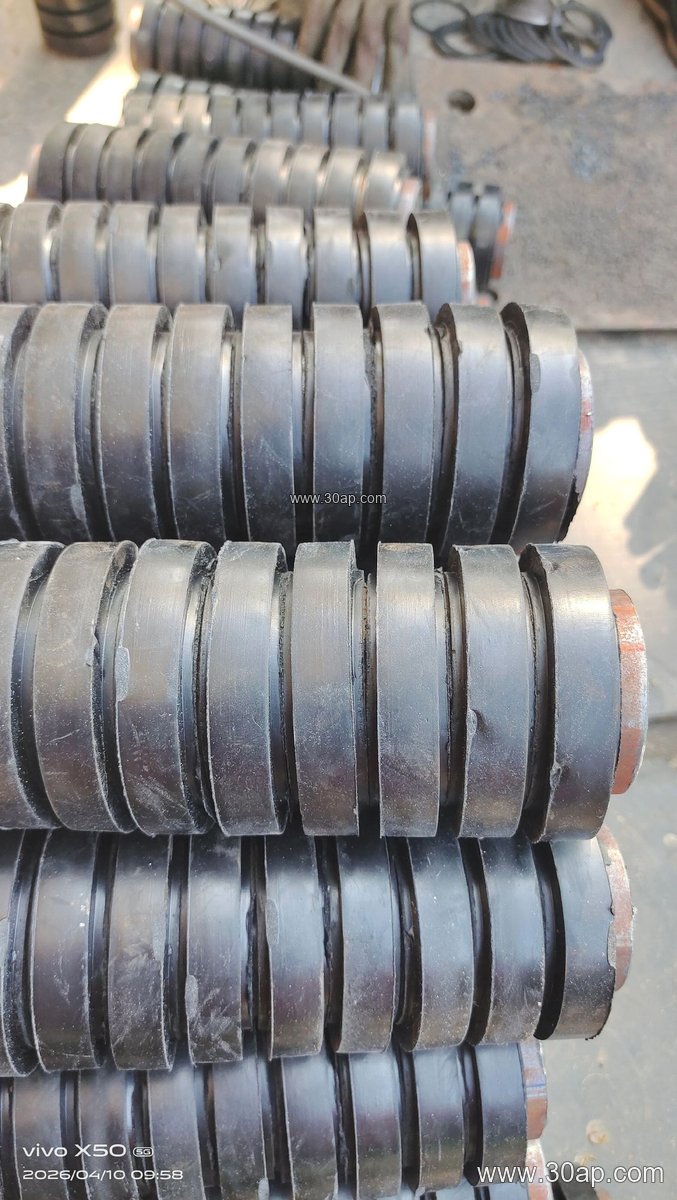
Bearing choice is matched to load and speed rather than to roller diameter alone; 6205, 6305, 6306, and 6308 are common in medium sizes, with heavier bearings used on larger rollers. Rubber-ring rollers are sometimes chosen on the alignment set at a transfer point, where impact resistance matters as much as tracking.
Where These Sets Are Used
Self-aligning sets earn their place on conveyors that are long, curved in plan, or fed off-center. In a quarry or aggregate line, a set after the crusher discharge helps a heavily loaded belt settle back to center. In a coal handling system at a power plant, alignment sets on the inclined gallery reduce edge wear on a flame retardant conveyor belt. Cement plants use them on clinker and limestone runs, while port and ship loading conveyors rely on them to keep long belts tracking under variable wind and loading.
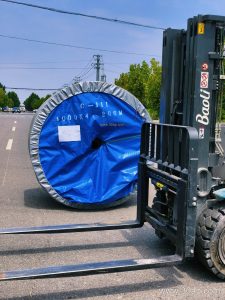
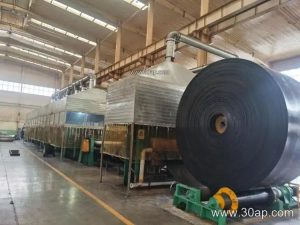
They are also useful where the belt itself is stiff or heavy, such as a steel cord conveyor belt on a high-tension run, or where a chevron conveyor belt or corrugated sidewall belt tends to wander because of uneven loading. In each case the set is a tracking device, not a substitute for proper pulley alignment.
Matching the Set to the Conveyor
Buyers should confirm belt width, trough angle, roller diameter, roller length, and mounting dimensions before ordering. The table below shows common reference values; final dimensions are set by the conveyor design.
| Item | Common reference values |
|---|---|
| Belt width | B500, B650, B800, B1000, B1200, B1400, B1600, B1800, B2000 |
| Roller diameter | Ø76, Ø89, Ø102, Ø108, Ø127, Ø133, Ø159, Ø178 |
| Trough angle | 20°, 30°, 35°, 45° |
| Roller length, three-roll example | about 250 mm at B650, 315 mm at B800, 380 mm at B1000, 465 mm at B1200 |
| Bearing | 6204, 6205, 6305, 6306, 6308, 6310 |
These are typical examples, not fixed pairings. A B1000 belt can be served by more than one roller diameter, and roller length changes with trough angle and set form. Forward tilt of about 1.5 to 2 degrees is common on self-aligning rollers and should be confirmed with the supplier.
Installation and Maintenance Notes
Placement matters more than quantity. Put alignment sets where misalignment starts: after the feed point, before and after curves, and on long straight sections at intervals set by the conveyor designer. Keep the pivot free of packed material, check that the frame swings without binding, and inspect roller rotation at each service stop. Worn rollers or seized bearings defeat the self-correcting action and can make tracking worse.
At chute transfers, consider a rubber-ring impact set alongside the alignment set, and check that the conveyor pulley and conveyor bracket are square before blaming the idlers. For abrasive ore or heavy rock, an abrasion resistant conveyor belt paired with well-maintained rollers gives the best service life. Buyers comparing suppliers should ask for the pivot design, seal type, bearing brand class, and dimensional drawing, since two sets with the same roller diameter can differ greatly in frame stiffness and sealing quality.